NIT Rourkela Team Develops AI Sleeping-Posture System
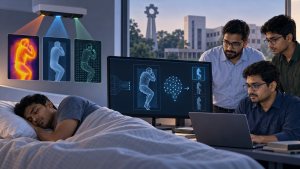
Researchers at the National Institute of Technology Rourkela in Odisha have developed an AI-enabled system to track human sleeping postures. Laboratory tests showed approximately 98% accuracy.
How the system works
The system monitors posture without using conventional visible-light images, helping preserve visual privacy. It combines long-wave infrared sensors that capture body heat, depth sensors that map body shape and posture, and pressure sensors that assess weight distribution on a bed. A generative AI model and a graph-based neural network process the combined data to classify body positions.
Research and intended use
The technology is intended for non-intrusive monitoring of hospital patients, older people and individuals with sleep apnoea. The findings were published in the IEEE Sensors Journal. The team includes Assistant Professor Saptarshi Chatterjee and B.Tech student Shiladitya Mondal of NIT Rourkela, and Assistant Professor Debangshu Dey of Jadavpur University. An integrated module is estimated to cost about Rs 30,000, with the potential for lower costs through mass-scale development.
Important Facts for Exams
- Infrared wavelength: Infrared radiation has wavelengths longer than visible light but shorter than microwaves, placing it beyond the visible spectrum.
- Thermal imaging: Thermal imaging forms pictures from infrared radiation emitted by objects, revealing differences in their surface temperatures.
- Depth maps: Range imaging assigns distance values to image points, producing a two-dimensional representation of depth in a scene.
- Graph message passing: Graph neural networks update node representations by exchanging information with neighbouring nodes, allowing the model to aggregate local relationships.
| Related | |
|---|---|