India’s Kaveri Engine Programme Reaches Milestone
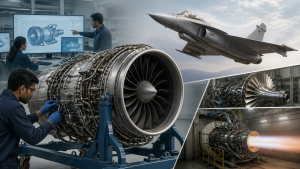
India’s Kaveri dry engine programme reached a major development stage in September 2026 when the engine recorded a peak dry thrust of 48.5 kilonewtons during high-altitude and flight trials in Russia. The engine, also called the Kaveri Derivative Engine, is being developed by the Defence Research and Development Organisation’s Gas Turbine Research Establishment in Bengaluru for the planned Ghatak stealth Unmanned Combat Aerial Vehicle.
Kaveri Engine Programme
The Kaveri programme is India’s indigenous aero-engine development effort for military aviation. The dry variant is a non-afterburning turbofan engine, while the afterburning version is designed to provide higher thrust for combat aircraft applications.
- The Kaveri dry engine achieved 48.5 kN of peak dry thrust during recent trials in Russia.
- The target dry thrust for the engine is about 46 kN.
- The programme is led by the Gas Turbine Research Establishment, a laboratory under the Defence Research and Development Organisation.
- The engine is intended for the Ghatak stealth UCAV, which is India’s planned unmanned combat aerial platform.
Flight Trials and Test Facilities
The trials were conducted at the Central Institute of Aviation Motors and the Gromov Flight Research Institute in Russia. Flight testing used a modified Ilyushin Il-76 flying testbed, with one standard engine replaced by the Kaveri engine for evaluation in actual flight conditions.
- The Central Institute of Aviation Motors is a Russian aero-engine research institution.
- The Gromov Flight Research Institute is a Russian aviation test and research facility.
- The Ilyushin Il-76 is a four-engine Soviet-designed transport aircraft often used as a flying testbed.
- Flight trials allow engine performance to be assessed under real atmospheric and operational conditions.
Certification and Future Variants
The Ministry of Defence has set 2026 as the target year for certifying the indigenous Dry Kaveri engine. The Centre for Military Airworthiness and Certification will examine the test data before granting airworthiness clearance, and certification will be followed by integration with the platform.
- The Centre for Military Airworthiness and Certification is responsible for airworthiness evaluation in India’s military aviation sector.
- The non-afterburning Kaveri engine was approved for inflight testing on 23 December 2024.
- Kaveri 2.0 is being developed as a more powerful version of the engine.
- Kaveri 2.0 is expected to deliver 55–60 kN of dry thrust and 90–100 kN with an afterburner.
Important Facts for Exams
- Dry thrust refers to engine thrust without afterburner use.
- Afterburners are used in jet engines to increase thrust by injecting fuel into the exhaust stream.
- Ghatak is India’s planned stealth Unmanned Combat Aerial Vehicle.
- GTRE is based in Bengaluru and functions under the Defence Research and Development Organisation.
| Related | |
|---|---|