Indian Scientists Identify Martian Analogue Sites
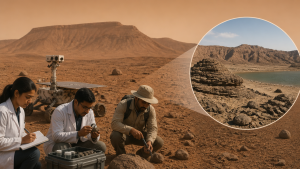
On 16 October 2026, Indian scientists identified terrestrial sites in Tamil Nadu and Chile containing minerals that provide geological analogues for studying Mars. The minerals are melanterite, found at Neyveli, and gypsum, found in the Tiruchirappalli Badlands and the Atacama Desert. Both are hydrous sulphates associated with water-rock interactions.
Terrestrial Analogues and Sites
A terrestrial analogue is an Earth environment or material used to study conditions and processes relevant to another planetary body. The Neyveli site in Tamil Nadu contains melanterite, while the Tiruchirappalli Badlands contain gypsum. Gypsum was also identified in Chile’s Atacama Desert, an arid region in South America. The mineral sites have geological, chemical and physical similarities to environments on Mars. Their mineral records can be examined to understand past water activity and environmental conditions on the planet. The Atacama Desert is also used in planetary science research because its dry environment provides a terrestrial setting for studying selected Mars-related conditions.
Hydrous Sulphate Minerals
Hydrous sulphates are sulphate minerals that contain water in their crystal structure. Gypsum has the chemical formula CaSO₄·2H₂O, while melanterite has the formula FeSO₄·7H₂O. These minerals can preserve evidence of interactions between water and rocks. Melanterite is associated with transient wet, acidic and oxidising conditions. Its formation can occur through the oxidation of sulphide minerals, a process relevant to the formation of sulphates on Mars. Gypsum forms in aqueous environments and can preserve evidence of past water. Its mineral matrix may also protect biosignatures, or traces of past life, from later environmental change.
Mineral Detection and Research
The research was led by Dr Sajin Kumar K.S., Project Coordinator of the DST-FIST programme at the Department of Geology, University of Kerala. Researchers used an advanced laser Raman spectrometer supported by DST-FIST to identify the minerals through their spectral fingerprints. Raman spectroscopy identifies materials by measuring changes in the wavelength of light scattered from a sample. The findings appeared in two research papers in the “Journal of Geophysical Research: Planets”. The papers discuss the mineral sites as terrestrial analogues for investigating past water activity and potentially habitable environments on Mars.
Important Facts for Exams
- Mars is the fourth planet from the Sun and is classified as a terrestrial planet.
- Gypsum is a hydrated calcium sulphate mineral with the formula CaSO₄·2H₂O.
- Melanterite is a hydrated iron sulphate mineral with the formula FeSO₄·7H₂O.
- Raman spectroscopy is based on the inelastic scattering of light by matter.
The Department of Geology at the University of Kerala is based in Thiruvananthapuram, Kerala. The Atacama Desert lies mainly in northern Chile.
| Related | |
|---|---|