Scientists Identify More Than 10,000 Faults on the Shrinking Moon
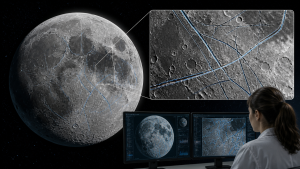
A study published on 14 October 2026 in The Planetary Science Journal identified more than 10,000 young faults across the Moon. Led by Thomas R. Watters, a scientist emeritus at the Smithsonian’s National Air and Space Museum, the research used imagery from NASA’s Lunar Reconnaissance Orbiter Camera (LROC).
Lunar Contraction and Fault Formation
The Moon’s interior has cooled over geological time, causing the lunar body to contract. The study estimates that its radius has decreased by approximately 45 metres over the past 400–800 million years. If the rate has remained constant, the Moon is shrinking by about 6–11 centimetres per million years, or roughly 0.1 micrometres annually. Contraction places the lunar crust under compressional stress and can produce thrust faults. A thrust fault forms when rock on one side of a low-angle fracture moves over rock on the other side. On the Moon, surface expressions of contraction include lobate scarps and small mare ridges.
Lunar Surface Features and Seismic Activity
Lobate scarps are curved, cliff-like landforms associated with displacement along faults. Mare ridges are raised structures found on the basaltic plains called lunar maria. The newly identified faults occur across the lunar surface and are described as young in geological terms. Fault movement can generate moonquakes. Unlike Earth, which has multiple tectonic plates, the Moon is a single-plate body. Moonquakes can occur at different locations on the lunar surface without advance warning.
Implications for Lunar Mission Planning
Some proposed landing sites for future lunar missions, including NASA’s Artemis program, are near active fault zones. Researchers recommend that mission planning include seismic risk assessments for landing-site selection and surface operations. The study also notes that areas with thicker lunar crust appear to have fewer faults and may be considered when assessing sites for lunar infrastructure.
Important Facts for Exams
- NASA launched the Lunar Reconnaissance Orbiter in 2009 to study the Moon and map its surface.
- The lunar maria are broad plains formed mainly by ancient basaltic lava flows.
- Thrust faults form under compressional stress, when one block of rock moves over another.
- The Artemis programme is NASA’s human lunar exploration programme.
The study used LROC data to identify more than 10,000 young lunar faults. It estimates a lunar radius reduction of about 45 metres over 400–800 million years.
| Related | |
|---|---|