India, South Korea Sign 16 MoUs to Boost Trade
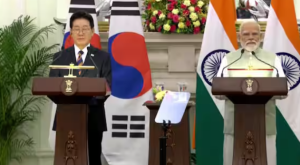
India and South Korea have signed 16 Memorandums of Understanding (MoUs) across sectors such as semiconductors, green energy, e-mobility and advanced manufacturing, aiming to double bilateral trade to 54 billion US dollars by 2030. The agreements were signed during South Korean President Lee Jae-myung’s visit to India and his talks with Prime Minister Narendra Modi. The partnership comes at a time of rising inflation risks, energy insecurity and global supply chain disruptions caused by geopolitical tensions.
Trade target and CEPA upgrade
Both countries currently have bilateral trade of around 27 billion US dollars and are targeting nearly 18 per cent annual growth to reach 54 billion US dollars by 2030. To achieve this, India and South Korea are working to upgrade the Comprehensive Economic Partnership Agreement (CEPA), originally signed in 2009. The focus is on removing non-tariff barriers, simplifying rules of origin, improving market access and making business operations easier for companies on both sides.
Focus on future industries
The new agreements prioritise sectors expected to shape the global economy over the next two decades. These include semiconductors, electronics, batteries, electric mobility, shipbuilding, digital trade and clean energy. Both sides also discussed co-production, co-design and co-innovation for global markets. A Korea-specific industrial township with plug-and-play infrastructure is also being planned in India to attract more South Korean investment and support manufacturing expansion.
Clean energy and climate cooperation
A major part of the partnership involves green energy and climate commitments. India and South Korea agreed to cooperate under Article 6.2 of the Paris Agreement, which allows international carbon market collaboration through trading emission reductions. India reaffirmed its net-zero target for 2070, while South Korea maintained its 2050 target. Cooperation in renewable energy, green hydrogen and battery technology is expected to reduce dependence on fossil fuels and improve energy security.
Important Facts for Exams
- CEPA stands for Comprehensive Economic Partnership Agreement and was signed between India and South Korea in 2009.
- Article 6.2 of the Paris Agreement allows carbon trading cooperation between countries.
- India aims for net-zero carbon emissions by 2070, while South Korea targets 2050.
- Semiconductors, batteries and e-mobility are key sectors for future global industrial competition.
Parallel trade talks with the United States
At the same time, India is also close to finalising the first tranche of a bilateral trade agreement with the United States. Commerce Minister Piyush Goyal said the deal is “almost finalised,” showing India’s broader strategy of diversifying economic partnerships. By strengthening ties with both South Korea and the US, India aims to improve supply chain resilience, reduce dependence on any single market and strengthen its position in the global economic order.
| Related | |
|---|---|