Important Concepts in Reusable Launch Vehicles
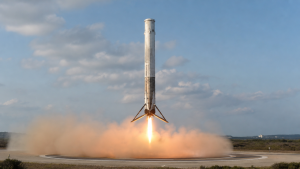
Reusable launch vehicles are designed for repeated missions rather than single use. They are important because they can reduce launch costs, shorten turnaround time and support more frequent access to space. For India, they also reflect a wider push toward indigenous space hardware, private sector participation and technology maturation across propulsion, recovery and controlled-descent systems.
Reusable Launch Vehicles
Reusable Launch Vehicles (RLVs) are space launch systems built for multiple missions, unlike traditional expendable rockets. Their central idea is simple: recover and reuse expensive hardware instead of discarding it after one flight.
- Cost reduction: Reuse lowers manufacturing expense, since major stages and systems do not need to be built anew for every mission.
- Higher launch frequency: Faster turnaround between flights can improve mission cadence and operational flexibility.
- Space sustainability: Reusing hardware helps reduce launch-related waste and the accumulation of space debris.
- Recovery systems: RLVs rely on descent mechanisms, controlled landing technologies and post-flight recovery processes.
- Levels of reusability: Some vehicles focus only on first-stage recovery, while more advanced concepts aim at system-level reusability, including upper-stage recovery and related support systems.
- Engineering challenge: Reusability demands precise control during ascent, re-entry, descent and landing, making it a complex but high-value capability.
System-Level Reusability and Agnibaan RLV
The Agnibaan RLV is designed for system-level reusability, which makes it more ambitious than conventional first-stage recovery concepts. It includes a reusable upper stage, descent systems and recovery systems, along with technologies needed for controlled operations across the full flight profile.
- Reusable upper stage: Extends reusability beyond the first stage and improves the long-term economics of launch operations.
- Descent systems: Help manage re-entry and controlled return through the atmosphere.
- Recovery systems: Support retrieval and reuse of flight hardware after mission completion.
- Flight phases covered: The development programme includes propulsion, ascent, orbital insertion, controlled descent and recovery.
- Lightweight upper stage: A lighter upper stage supports performance efficiency and reusability goals.
- Operational relevance: Such designs are closely linked to reducing per-launch cost while improving mission reliability and sustainability.
Technology Readiness Levels (TRLs)
Technology Readiness Levels (TRLs) are a standard scale used to measure how mature a technology is. The scale helps policymakers, engineers and investors understand whether a technology is still in the laboratory stage or ready for operational use.
| TRL 1 | Basic principles observed. |
| TRL 2 | Technology concept and/or application formulated. |
| TRL 3 | Proof-of-concept through analytical and experimental work. |
| TRL 4 | Component or breadboard validation in a laboratory environment. |
| TRL 5 | Component or breadboard validation in a relevant environment. |
| TRL 6 | System or subsystem model or prototype demonstrated in a relevant environment. |
| TRL 7 | System prototype demonstrated in a space environment. |
| TRL 8 | Actual system completed and qualified through test and demonstration. |
| TRL 9 | Actual system proven in an operational environment. |
- Why TRLs matter: They provide a common framework for assessing technical maturity across sectors.
- From concept to deployment: A technology moves from experimentation to real-world application through repeated testing and validation.
- Exam relevance: TRL 8 means the technology has been completed and qualified through tests and demonstrations, and is proven in its final form under expected operating conditions.
- Policy relevance: TRLs are useful in public funding because they indicate how close a project is to operational readiness.
Propulsion Systems and Agnilet Engine
Propulsion is central to RLV development because reusable systems must perform efficiently during launch and still remain controllable for return and recovery. Semi-cryogenic liquid propulsion systems are important in this context.
- Semi-cryogenic propulsion: These systems use liquid oxygen as a cryogenic oxidizer and a fuel stored at ambient temperature, such as refined kerosene or RP-1.
- Infrastructure advantage: Compared with fully cryogenic systems, they can simplify ground handling and support operations.
- Performance benefit: They offer higher thrust-to-weight ratios than storable propellants.
- Deep throttling: This allows the engine thrust to be varied significantly during flight, which is essential for controlled descent and landing.
- Restart capability: Engines that can ignite multiple times are needed for orbital insertion, de-orbit burns and descent maneuvers.
- Agnilet engine: Developed by Agnikul Cosmos, it features a single-piece, fully 3D-printed combustion chamber, reducing complexity and manufacturing time.
- Integration with Agnibaan: The engine is a key part of the Agnibaan RLV and supports controlled ascent and mission precision.
Technology Development Board, RDI Fund and Private Space Sector
The Technology Development Board (TDB) is a statutory body under the Department of Science and Technology (DST), established by the Technology Development Board Act, 1995. It promotes the development and commercialization of indigenous technology and helps adapt imported technology for wider use.
- RDI Fund: The Research Development and Innovation Fund is a Government of India initiative under the DST and the Anusandhan National Research Foundation (ANRF).
- Launch date: It was launched in November 2025 to accelerate investment in India’s R&D and innovation ecosystem.
- Target users: The fund supports private sector enterprises, startups and industries working in strategic sectors.
- TDB role: TDB is one of the designated Second-Level Fund Managers for the RDI Fund.
- Funding instrument: Support is provided through Optionally Convertible Debentures (OCDs), which are debt instruments that may be converted into equity shares at specified terms or redeemed for cash.
- Private space push: India’s space sector is increasingly focused on launch vehicles, satellites, propulsion systems and recovery technologies.
- Industry relevance: Reusability, semi-cryogenic propulsion and controlled descent are among the important engineering areas currently shaping launch vehicle development.
Key Prelims Takeaways
- Reusable launch vehicles are designed for repeated missions and lower launch costs.
- Reusability also supports higher launch frequency and reduced space debris.
- TRLs measure technology maturity from TRL 1 to TRL 9.
- TRL 8 means the actual system is completed and qualified through test and demonstration.
- Semi-cryogenic propulsion uses liquid oxygen with a fuel stored at ambient temperature.
- Deep throttling and restart capability are crucial for reusable launch vehicle operations.
- Agnilet engine has a single-piece, fully 3D-printed combustion chamber.
- TDB is a statutory body under the DST, established by the Technology Development Board Act, 1995.
- RDI Fund operates under the DST and ANRF and was launched in November 2025.
- OCDs are debt instruments that can be converted into equity or redeemed for cash.
- Agnibaan RLV is designed for system-level reusability, including upper-stage recovery.
- Agnikul Cosmos is a Chennai-based private aerospace company with India’s first private launchpad and mission control center at Sriharikota.
Recent Context
The Technology Development Board and DST signed an agreement with Agnikul Cosmos to provide ₹200 crore from the RDI Fund for the Agnibaan RLV project. The support is being extended through OCDs and is aimed at moving the vehicle from TRL 4 and above to TRL 8, reflecting stronger public support for private space innovation.
| Related | |
|---|---|