Important Concepts in Quantum Computing
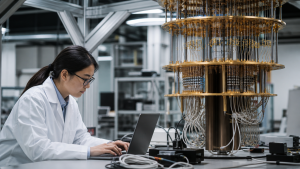
Quantum computing uses qubits and quantum-mechanical effects such as superposition, entanglement, and interference to solve certain problems far faster than classical computers. It is a fast-evolving field with major implications for cryptography, chemistry, optimization, and national technology capability.
Classical Bits vs. Quantum Bits
The fundamental unit of information determines how a computer processes data. The table below shows the main differences between classical bits and qubits.
| Feature | Classical Bit | Qubit (Quantum Bit) |
| Basic Unit | 0 or 1 | Superposition of 0 and 1 |
| Physical Form | Electrical voltage or silicon transistors | Atoms, ions, photons, or electrons |
| Information State | Binary state | Infinite states on a Bloch sphere |
| Processing Type | Sequential calculations | Simultaneous parallel calculations |
| Data Capacity | N bits store N states | N qubits store 2N states simultaneously |
| Error Susceptibility | Very low; corrected easily | Very high; sensitive to environmental noise |
Core Principles of Quantum Computing
Quantum mechanics introduces three physical phenomena that govern how qubits function.
Superposition
Superposition is the ability of a qubit to exist in multiple states at the same time. While a classical bit is restricted to 0 or 1, a qubit exists as a linear combination of both states. It resolves into a definite state only when measured.
Entanglement
Entanglement occurs when two or more qubits become linked so that the state of one is directly related to the state of the other, regardless of distance. This property helps quantum computers process information in ways not possible for classical circuits.
Quantum Interference
Quantum interference helps control quantum states and guide them toward the correct solution. Quantum algorithms use constructive interference to amplify correct answers and destructive interference to suppress incorrect ones.
Primary Quantum Technologies and Hardware
- Superconducting Qubits: Tiny superconducting electrical circuits cooled to near absolute zero. They are widely used by firms such as IBM and Google.
- Trapped Ion Qubits: Individual charged atoms are suspended in a vacuum using electromagnetic fields, and lasers control their state.
- Photonic Qubits: Individual photons carry quantum information. They are stable and do not require extreme cooling.
- Topological Qubits: An experimental approach that stores information by braiding quasiparticles called anyons.
Key Quantum Algorithms
- Shor’s Algorithm: Developed by Peter Shor in 1994, it factors large integers exponentially faster than known classical algorithms. It threatens RSA encryption.
- Grover’s Algorithm: Developed by Lov Grover in 1996, it searches unstructured databases quadratically faster than classical systems.
Critical Terms and Concepts
- Quantum Decoherence: The loss of quantum behavior in qubits due to temperature changes, electromagnetic fields, or vibrations.
- Quantum Error Correction (QEC): A method that spreads one logical qubit across several physical qubits to detect and correct errors.
- Quantum Supremacy: The point at which a quantum computer performs a calculation impractical for a classical supercomputer.
- No-Cloning Theorem: It is impossible to create an identical copy of an arbitrary unknown quantum state.
Applications of Quantum Computing
- Cryptography: Quantum Key Distribution (QKD) enables ultra-secure communication, while Post-Quantum Cryptography (PQC) prepares classical encryption for future quantum attacks.
- Molecular Modeling and Chemistry: Quantum computers can simulate molecular interactions for drug discovery, materials research, and catalyst design.
- Optimization Problems: They can help solve complex logistics, financial, and supply chain problems.
India’s National Quantum Mission (NQM)
- Objective and Duration: Approved in 2023, the mission runs for eight years until 2031 under the Department of Science and Technology.
- Key Targets: It aims to develop quantum computers with 50 to 1,000 physical qubits using superconducting and photonic platforms.
- Communication Targets: It seeks secure satellite-based quantum communications over 2,000 km and secure ground-based fiber links.
- Thematic Hubs: Four T-Hubs have been set up in Indian research institutions for quantum computing, communication, sensing and metrology, and quantum materials and devices.
Recent Context
QpiAI inaugurated an 8-inch QPU manufacturing facility in Bengaluru in August 2026 as part of its Phase 2 expansion. The company plans indigenous quantum hardware production, with a roadmap to scale to 10,000 physical qubits on a single QPU by 2027.
Rare Facts for Prelims
- Bloch Sphere: A qubit’s state is often visualized on a sphere, unlike a classical bit which has only two states.
- Cryogenic Need: Superconducting qubits typically operate at temperatures close to absolute zero.
- Anyons: Topological qubits are based on exotic quasiparticles that are not ordinary particles.
- QKD Limitation: Quantum Key Distribution secures key exchange, but it does not by itself encrypt the message content.
- Quantum Advantage: This term is often used for a practical speedup on a specific task, even if full supremacy is not achieved.
- 3D Chip-Stacking: Vertical chip layering is used to increase device density in advanced semiconductor design.
| Related | |
|---|---|