Major Industrial Corridors in India
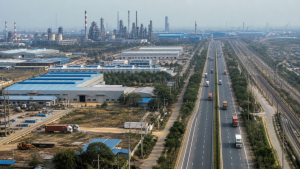
Industrial corridors are planned zones that combine manufacturing clusters, transport links, and logistics infrastructure to reduce costs and promote regional development. In India, they are being developed under the National Industrial Corridor Development Programme (NICDP) with support from the Centre and states.
Conceptualizing Industrial Corridors in India
Industrial corridors are structured geographical zones designed to integrate manufacturing clusters with modern logistics networks. These zones align key transport links such as highways, Dedicated Freight Corridors (DFCs), ports, and airports to lower overall logistics costs.
The National Industrial Corridor Development Programme (NICDP) is the premier administrative programme managing these developments. Under this programme, the government builds greenfield industrial smart cities with advanced plug-and-play facilities.
Institutional Framework and Governance
Administrative Bodies
- National Industrial Corridor Development and Implementation Trust (NICDIT): This is the apex administrative body. It functions under the Department for Promotion of Industry and Internal Trade (DPIIT), Ministry of Commerce and Industry.
- Apex Monitoring Authority: Chaired by the Union Finance Minister, this high-level authority reviews project progress, land acquisition, and financial disbursements.
- National Industrial Corridor Development Corporation (NICDC) Limited: This agency manages project design, execution, and investor facilitation.
Centre-State Implementation Model
- Land Sourcing: State governments identify and provide contiguous, encumbrance-free land parcels.
- Trunk Infrastructure Funding: The Central Government contributes matching funds as equity or debt for the development of trunk infrastructure.
- Special Purpose Vehicles (SPVs): Each node is managed by a joint-venture SPV formed between the central government (via NICDIT) and the respective state government. Most SPVs operate under a 50:50 or 51:49 partnership model.
The 11 Approved Industrial Corridors
The government has approved the development of 11 distinct industrial corridors under the NICDP. These corridors span multiple states and connect key economic and commercial centres.
| Corridor Name | Primary States Covered | Core Infrastructure Backbone |
| Delhi Mumbai Industrial Corridor (DMIC) | Uttar Pradesh, Delhi NCR, Haryana, Rajasthan, Gujarat, Maharashtra, Madhya Pradesh | Western Dedicated Freight Corridor (DFC) |
| Chennai Bengaluru Industrial Corridor (CBIC) | Tamil Nadu, Andhra Pradesh, Karnataka | National Highways and Southern Rail Links |
| Amritsar Kolkata Industrial Corridor (AKIC) | Punjab, Haryana, Uttarakhand, Uttar Pradesh, Bihar, Jharkhand, West Bengal | Eastern Dedicated Freight Corridor (DFC) |
| East Coast Industrial Corridor (ECIC) | West Bengal, Odisha, Andhra Pradesh, Tamil Nadu | National Highway 16 and East Coast Rail Link |
| Bengaluru Mumbai Industrial Corridor (BMIC) | Karnataka, Maharashtra | National Highway 48 and Bengaluru-Mumbai Railway |
| Extension of CBIC to Kochi via Coimbatore | Tamil Nadu, Kerala | National Highways and South-Western Railway |
| Hyderabad Nagpur Industrial Corridor (HNIC) | Telangana, Maharashtra, Andhra Pradesh | National Highway 44 |
| Hyderabad Warangal Industrial Corridor (HWIC) | Telangana | National Highway 163 |
| Hyderabad Bengaluru Industrial Corridor (HBIC) | Telangana, Andhra Pradesh, Karnataka | National Highway 44 |
| Odisha Economic Corridor (OEC) | Odisha | National Highways and East Coast Rail Network |
| Delhi Nagpur Industrial Corridor (DNIC) | Delhi, Uttar Pradesh, Madhya Pradesh, Maharashtra | National Highway 44 and Central Railway Links |
Current Development Status of Key Industrial Nodes
The development of corridors occurs through specific industrial smart cities. A total of 20 industrial nodes are approved under the NICDP, classified by their current development stage.
Completed Projects
Four greenfield industrial smart cities are complete and have entered the production phase:
- Dholera Special Investment Region (Gujarat): This is an advanced manufacturing hub equipped with high-capacity water transmission, sewage treatment, and dedicated power grids.
- Shendra-Bidkin Industrial Area (AURIC, Maharashtra): The Bidkin phase was dedicated to the nation in September 2024. It caters primarily to engineering, automobile, and food processing sectors.
- Integrated Industrial Township, Greater Noida (Uttar Pradesh): Dedicated to the nation in January 2024, focusing on electronics and ICT-enabled manufacturing.
- Integrated Industrial Township, Vikram Udyogpuri (Madhya Pradesh): Dedicated in October 2023 near Ujjain, hosting manufacturing and chemical processing units.
Projects Nearing Completion
Four key logistics and industrial hubs are under active implementation:
- Tumakuru Industrial Area (Karnataka): Part of the CBIC, spanning 1,736 acres with Jindal Aluminium as the anchor investor.
- Krishnapatnam Industrial Area (Andhra Pradesh): Spanning 812 hectares, linking coastal shipping networks with inland manufacturing.
- Integrated Multi-Modal Logistics Hub (IMLH), Nangal Chaudhary (Haryana): A major dry port facility facilitating cargo movement from northern states.
- Multi-Modal Logistics Hub & Multi-Modal Transport Hub (MMLH & MMTH), Dadri (Uttar Pradesh): Serves as a primary freight interchange hub.
The 12 Newly Approved Nodes
In August 2024, the Cabinet Committee on Economic Affairs (CCEA) approved 12 new industrial nodes across 10 states under the NICDP. These projects involve an estimated investment of Rs 28,602 crore, with a target to generate 1 million direct and 3 million indirect jobs.
| Node/City Name | State | Area Allocated | Key Sector Focus |
| IMC at Khurpia Farm | Uttarakhand | 1,002 Acres | Manufacturing, Green Industries |
| IMC at Rajpura-Patiala | Punjab | 1,099 Acres | Food Processing, Engineering |
| Dighi Port Industrial Area | Maharashtra | 6,056 Acres | Port-led Manufacturing, Heavy Industry |
| Palakkad Industrial Area | Kerala | 1,710 Acres | Electronics, Food Processing, MSMEs |
| Jodhpur Pali Marwar | Rajasthan | 1,578 Acres | Textiles, Handicrafts, Chemicals |
| IMC at Hisar | Haryana | 2,988 Acres | Aerospace, General Engineering |
| IMC at Agra | Uttar Pradesh | 1,058 Acres | Leather, Engineering, Handicrafts |
| IMC at Prayagraj | Uttar Pradesh | 352 Acres | Glass, Electroplating, MSMEs |
| IMC at Gaya | Bihar | 1,670 Acres | Textiles, Agro-industries, Logistics |
| Orvakal Industrial Area | Andhra Pradesh | 2,621 Acres | Green Energy Components, Chemicals |
| Kopparthy Industrial Area | Andhra Pradesh | 2,595 Acres | Textiles, Electronics, Hardware |
| Zaheerabad Industrial Area | Telangana | 3,245 Acres | Defense, Automobile, Engineering |
Policy Frameworks and Key Initiatives
Bharat Audyogik Vikas Yojna (BHAVYA)
The Union Cabinet approved the BHAVYA scheme as a Central Sector Scheme with an allocation of Rs 33,660 crore. It operates for a period of six years from financial year 2026-27 to 2031-32.
- Target: The scheme aims to develop 100 investment-ready, plug-and-play industrial parks across India.
- Infrastructure Support: The central government provides up to Rs 1 crore per acre for internal core infrastructure (roads, utility corridors, common effluent treatment) and funds up to 25% of external connectivity costs.
- Selection via Challenge Mode: Participating states are chosen through a competitive challenge process, ensuring that land parcels are contiguous, free of disputes, and economically viable.
- Coexistence Model: The parks promote a walk-to-work culture by integrating residential and commercial spaces close to industrial zones.
Budget 2026-27 Allocations
- Financial Outlay: The 2026-27 Union Budget allocated Rs 3,000 crore to NICDIT.
- Purvodaya Initiative Focus: Under the East Coast Industrial Corridor, a major new node has been prioritised at Durgapur in West Bengal. This step supports the economic revitalisation of India’s eastern region.
- Alignment with PM GatiShakti: All industrial nodes are mapped on the PM GatiShakti National Master Plan. This integration ensures multi-modal connectivity, reducing transport time and transaction costs.
Recent Context
The Tumakuru node in Karnataka has been reviewed under NICDIT’s Apex Monitoring Authority. It has reported 30% physical progress and 20% financial progress, with Jindal Aluminium as the anchor investor.
Key Facts and Exam Trivia
- First Corridor: The Delhi Mumbai Industrial Corridor (DMIC) was the first industrial corridor initiated in India. It covers an overall length of 1,504 km from Dadri in Uttar Pradesh to Jawaharlal Nehru Port Trust (JNPT) in Maharashtra.
- First Coastal Corridor: The Vizag Chennai Industrial Corridor (VCIC) forms Phase 1 of the East Coast Industrial Corridor (ECIC). It represents the first coastal economic corridor in India.
- Dedicated Freight Corridors: The DMIC runs parallel to the Western Dedicated Freight Corridor, while the Amritsar Kolkata Industrial Corridor (AKIC) aligns with the Eastern Dedicated Freight Corridor.
- National Land Bank Integration: All industrial plots available within the completed nodes are mapped on the India Industrial Land Bank (IILB) system. This database allows investors to view available industrial land in real time.
- Low-Carbon City Framework: Modern industrial smart cities, such as AURIC and Dholera, adopt green energy, mandatory water recycling, and continuous environment monitoring systems.
Rare Facts for Prelims
- NICDC role: NICDC Limited is the implementing arm, while NICDIT is the trust that provides overall coordination and oversight.
- DMIC length: The DMIC corridor is often cited as one of India’s most ambitious freight-led industrial projects due to its 1,504 km alignment.
- SPV model: Industrial corridor nodes are usually developed through joint SPVs, which help combine central funding with state-level land and approvals.
- Plug-and-play concept: These industrial parks are designed to provide ready utilities such as power, water, roads, and drainage before industries move in.
- Logistics integration: Corridor planning is closely linked with ports, rail freight, highways, and airports to reduce turnaround time for cargo.
- Eastern focus: The Purvodaya approach gives special emphasis to eastern India through industrial and logistics-led growth.
| Related | |
|---|---|