Eyeless Freshwater Cave Snail Discovered in China
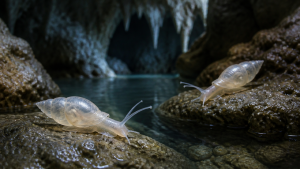
Erhaia dijiang is a newly described freshwater cave snail found in Yuxi City, Yunnan Province, China. Published in the journal Subterranean Biology in 2026, it is the first freshwater cave snail documented in China. The species was found at an elevation of 2,062 metres, the highest recorded for a cave snail in the family Erhaiidae.
Classification and Cave Adaptations
Erhaia dijiang belongs to Erhaiidae, a family of freshwater snails in the gastropod group. It is a troglobiont, an organism adapted to live exclusively in caves. The species has no functional eyes and lacks body pigmentation, traits associated with life in darkness. Its shell is cone-shaped and nearly transparent, and it has long, slender tentacles.
The species name dijiang refers to Di Jiang, a faceless mountain deity described in the ancient Chinese text Classic of Mountains and Seas. In laboratory observations, the snails retreated beneath rocks and into dark spaces when exposed to light, indicating strong photophobia.
Habitat and Diet
The snails inhabit shallow cave water, less than one metre deep, among submerged gravel and broken rock. Water temperature in the cave remains close to 20°C. Researchers found the animals within two metres of the cave entrance; they were not observed in nearby streams, including after seasonal rains occasionally washed some out of the opening.
The species feeds on diatoms, microscopic algae that grow on rock surfaces. Diatoms are photosynthetic organisms found in freshwater and marine environments, and they form part of aquatic food webs.
Population and Conservation
The first field investigation, conducted in August 2025, found three living adult snails and one empty shell. No juveniles were found. The small number of individuals recorded and the species’ restricted cave habitat leave its population size and long-term status uncertain.
Important Facts for Exams
- Troglobionts are organisms adapted to live exclusively in subterranean habitats such as caves.
- Erhaiidae is the family in which Erhaia dijiang is classified.
- Diatoms are microscopic algae with silica-based cell walls.
- Erhaia dijiang was described in the journal Subterranean Biology.
Erhaia dijiang is known from a cave in Yuxi City, Yunnan Province, at 2,062 metres above sea level. Its documented habitat consists of shallow, near-20°C cave water and submerged gravel and rock.
| Related | |
|---|---|