Conflicts in the Democratic Republic of the Congo
The Conflicts in the Democratic Republic of the Congo (DRC) represent one of the most prolonged and complex crises in modern African history. Marked by ethnic violence, political instability, and competition over natural resources, these conflicts have resulted in millions of deaths, widespread displacement, and enduring humanitarian challenges. Often referred to as “Africa’s World War,” the wars in the DRC have drawn in numerous neighbouring countries and armed groups, deeply affecting Central Africa’s political and security landscape.
Historical Background
The roots of conflict in the DRC can be traced to the colonial period under Belgian rule (1908–1960). Exploitation of mineral wealth, forced labour, and arbitrary borders laid the foundation for future tensions. After independence in 1960, the country, then called the Republic of the Congo (Léopoldville), quickly descended into chaos during the Congo Crisis (1960–1965), characterised by mutinies, secessionist movements (notably in Katanga), and Cold War rivalries.
In 1965, Joseph-Désiré Mobutu seized power through a coup and established an authoritarian regime under the name Mobutu Sese Seko. Renaming the country Zaire in 1971, Mobutu ruled for over three decades, supported by Western powers due to his anti-communist stance. His rule, however, was marked by corruption, patronage, and repression, which eroded state institutions and left deep socio-economic scars.
By the early 1990s, political opposition, economic decline, and regional instability — particularly the 1994 Rwandan Genocide — set the stage for renewed turmoil.
The First Congo War (1996–1997)
The First Congo War began in 1996 and led to the overthrow of Mobutu Sese Seko. The conflict was triggered primarily by the aftermath of the Rwandan Genocide, when Hutu militias (Interahamwe) responsible for the genocide fled into eastern Zaire, using refugee camps as bases to launch attacks on Rwanda.
Rwanda and Uganda, seeking to neutralise these militias, supported a rebel coalition called the Alliance of Democratic Forces for the Liberation of Congo-Zaire (AFDL), led by Laurent-Désiré Kabila. The AFDL advanced rapidly across the country, aided by local discontent against Mobutu’s regime.
In May 1997, Mobutu fled the country, and Kabila declared himself president, renaming the nation the Democratic Republic of the Congo. However, the new government soon faced challenges from former allies, setting the stage for a second, far more devastating conflict.
The Second Congo War (1998–2003)
The Second Congo War, also known as the Great African War, erupted in 1998 and became the deadliest conflict since the Second World War. It involved nine African nations and over twenty armed groups.
The war began when relations between President Kabila and his former Rwandan and Ugandan allies deteriorated. Rwanda and Uganda supported new rebel movements — notably the Rally for Congolese Democracy (RCD) and the Movement for the Liberation of Congo (MLC) — to overthrow Kabila. In response, Kabila received backing from Angola, Zimbabwe, Namibia, Chad, and Sudan.
The country was effectively divided, with rebel groups controlling vast eastern territories rich in minerals, while the government retained the western region, including Kinshasa.
Major consequences included:
- Massive civilian casualties, estimated at over five million deaths, largely due to disease, famine, and displacement.
- Systematic human rights abuses, including sexual violence, recruitment of child soldiers, and ethnic massacres.
- Exploitation of natural resources such as coltan, gold, diamonds, and cobalt, which fuelled the conflict through illicit trade.
- Destruction of infrastructure and institutions, leading to long-term economic collapse.
A ceasefire agreement, known as the Lusaka Peace Accord, was signed in 1999, leading to the deployment of the United Nations Mission in the Congo (MONUC). However, fighting continued intermittently until the Pretoria Accord of 2003, which formally ended the war and established a transitional government.
Post-war Instability and Continuing Conflicts
Despite the official end of the Second Congo War in 2003, violence has persisted, particularly in the eastern provinces of North Kivu, South Kivu, and Ituri. The region remains plagued by the presence of armed groups, ethnic militias, and foreign insurgents.
Key developments after 2003 include:
- 2006 Elections: The first democratic elections in over four decades brought Joseph Kabila, son of Laurent Kabila (assassinated in 2001), to power. However, governance challenges and corruption persisted.
- Rebel Movements: The emergence of groups such as the CNDP (National Congress for the Defence of the People) under Laurent Nkunda, later replaced by the M23 Movement, which seized Goma in 2012 before being defeated by government forces and UN intervention.
- Foreign Armed Presence: Groups like the Democratic Forces for the Liberation of Rwanda (FDLR), composed of Hutu extremists, and Allied Democratic Forces (ADF) from Uganda, continue to operate in the DRC, contributing to instability.
- Resource Conflicts: Competition over mining areas, especially for minerals like cobalt and coltan used in electronics, remains a major driver of violence. Armed groups exploit these resources to finance their activities, leading to what is termed “conflict minerals.”
- Humanitarian Crisis: Millions remain displaced, and widespread sexual violence has earned eastern DRC the grim description as the “rape capital of the world.”
International Involvement and Peacekeeping
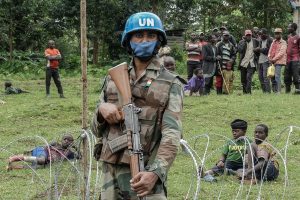
The United Nations has maintained a significant presence in the DRC through its peacekeeping missions:
- MONUC (United Nations Mission in the Democratic Republic of Congo) established in 1999 to monitor ceasefire agreements.
- MONUSCO (United Nations Organization Stabilization Mission in the Democratic Republic of Congo) succeeded MONUC in 2010, becoming one of the largest UN peacekeeping operations globally.
MONUSCO’s mandate includes protecting civilians, disarming militias, and supporting government stabilisation efforts. However, its effectiveness has been questioned due to continued insecurity and limited state control over eastern territories.
Humanitarian and Socio-economic Impact
The cumulative impact of decades of conflict has been catastrophic:
- Over six million deaths since 1996, mostly from preventable causes such as hunger and disease.
- More than five million internally displaced persons and over one million refugees in neighbouring countries.
- Persistent food insecurity and destruction of agricultural livelihoods.
- Rampant gender-based violence and trauma affecting generations.
- Collapse of healthcare, education, and infrastructure.
The exploitation of minerals has both sustained and intensified the conflict, linking global supply chains with human rights abuses.
Recent Developments
In recent years, the DRC has witnessed ongoing unrest despite periodic peace agreements. The M23 rebellion re-emerged in 2022, capturing territories in North Kivu, leading to renewed tensions between the DRC and Rwanda, which Kinshasa accuses of supporting the rebels.
Efforts by regional bodies such as the African Union (AU), East African Community (EAC), and Southern African Development Community (SADC) have focused on mediation, while peacekeeping operations continue under challenging circumstances.
Elections, most recently scheduled for 2023–2024, remain critical for democratic consolidation, though issues of governance, corruption, and state legitimacy continue to hamper peacebuilding.
| Related | |
|---|---|