China’s Trade Surplus Tops $1 Trillion for Second Year
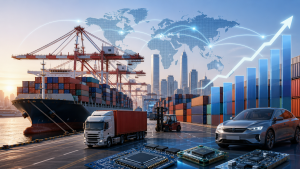
China recorded a trade surplus of 1.04 trillion from January to October 2026, official data released on 10 November showed. It is on track to exceed its 2025 record of 1.2 trillion, making this the second consecutive year with a surplus above $1 trillion.
Exports and trade outlook
In October, exports rose 35.2% year-on-year and imports increased 41.6%. The monthly surplus narrowed to 105.3 billion from 133.5 billion in September as imports picked up. High-tech goods, including semiconductors and automobiles, and demand for artificial intelligence-related products supported export growth.
Dave Chia of Moody’s Analytics expects exports, particularly electronics and autos, to remain strong through the rest of 2026. Alicia García-Herrero, chief economist for Asia Pacific at Natixis, attributed China’s export reliance to industrial overcapacity, excess domestic savings and weak domestic demand, and said the situation was unsustainable.
Risks include European Union trade curbs, higher United States barriers and tariffs, and possible setbacks in the artificial intelligence industry. A two-month extension of a US-China trade truce runs until January. Trade is expected to feature in planned meetings between US President Donald Trump and Chinese leader Xi Jinping at the Asia-Pacific Economic Cooperation leaders’ summit in Shenzhen on 18–19 November.
Strong exports have helped offset sluggish domestic demand. China is forecast to meet its annual growth target of 4.5%–5% in 2026, compared with 5% growth in 2025.
Important Facts for Exams
- Goods-only scope: China’s trade balance, under the IMF’s official definition, covers goods only; some other uses also include trade in services.
- Current-account link: A goods-trade surplus is one component of the current account, which also includes investment income and international aid.
- Output-demand relationship: A country’s trade balance also equals the gap between its output and domestic demand, linking a surplus to production relative to local purchases.
- Growth-cycle effect: During expansions, export-led growth tends to shift a country’s trade balance towards exports, while domestic-demand-led growth tends to shift it towards imports.
| Related | |
|---|---|