Celtic Prince’s Grave Found Near Bad Camberg
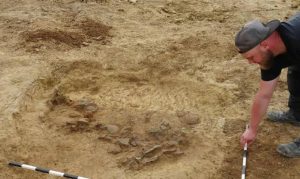
Archaeologists announced the discovery of a princely grave near Bad Camberg in Hesse, Germany, during excavations linked to a solar park. The burial dates to the early La Tène period, around the middle of the first millennium BCE, and the grave goods include gold jewellery, weapon fragments, and a bronze jug imported from Etruria.
La Tène Period
The La Tène period is the later Iron Age phase of Celtic Europe, generally dated from about 450 BCE to the Roman conquest of Celtic territories. It is named after the La Tène site on Lake Neuchâtel in Switzerland, which gave its name to a distinctive archaeological culture.
Princely Graves and Wagon Burials
Princely graves are elite burials associated with high-status individuals in Iron Age Europe. Such graves often contain weapons, imported vessels, ornaments, and wagon remains, and they are known from parts of central Europe, including Hesse.
- Only a small number of Celtic wagon burials have been found in Hesse.
- The Bad Camberg burial contains traces of a two-wheeled wagon, including wheel hub fittings, axle caps, and iron wheel rims.
- The wooden parts of the wagon had decayed, while the metal components survived in the grave.
- Some sections of the burial were removed as intact soil blocks for laboratory study.
Artefacts and Scientific Examination
The grave goods include several gold rings, one of which weighs 5 ounces, and a bronze jug imported from Etruria, the ancient region in central Italy. X-rays and CT scans have identified additional hidden objects inside the excavated soil blocks.
Important Facts for Exams
- La Tène culture is associated with the Iron Age Celts of Europe.
- Etruria was an ancient region in present-day Tuscany, Italy.
- Wagon burials are linked with elite burial customs in parts of Iron Age Europe.
- Hesse is a federal state in central Germany.
Archaeology in Solar Park Excavations
The grave was found during construction-related excavation work for a solar park, a type of land development that can expose buried archaeological remains. The discovery is the first known Celtic princely grave found during construction work for a solar park in Hesse.
| Related | |
|---|---|