Black Hole Spin and X-ray Variability
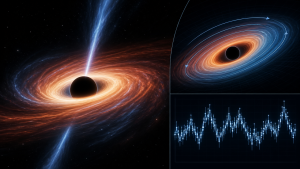
A study published in the Journal of High Energy Astrophysics on 23 October 2026 examined how black hole spin affects X-ray variability. Researchers from the Aryabhata Research Institute of Observational Sciences (ARIES), the Nicolaus Copernicus Astronomical Center in Poland and MJP Rohilkhand University used computer simulations of viscous accretion flows.
Accretion Flows and X-ray Variability
An accretion disk is a rotating structure of gas and other matter that spirals towards a compact object, including a black hole. Friction and other dissipative processes heat the material, causing it to emit radiation, including X-rays. The study modelled accretion shocks—regions where the flow undergoes abrupt changes in speed and physical conditions. The simulations found that a rapidly rotating black hole pulls accretion shocks closer to itself. The shock’s movement affects the frequency of quasi-periodic oscillations (QPOs), which are recurring variations in the X-ray emission from systems containing compact objects. For black holes with about ten times the Sun’s mass, the simulated QPO frequencies extended above 100 hertz.
Black Hole Spin and General Relativity
Black hole spin describes the rotation of a black hole and is a parameter in models of the surrounding space-time. In general relativity, a rotating mass causes frame-dragging, also known as the Lense-Thirring effect. This effect can cause the inner region of an accretion disk to precess, or change its orientation over time. In 2025, observations of the tidal disruption event AT2020afhd provided evidence of Lense-Thirring precession around a rapidly rotating black hole. A tidal disruption event occurs when a star passes close enough to a black hole for its gravity to tear the star apart. In 2024, researchers reported a method for estimating black hole spin by measuring the wobble of a disk formed after such an event.
Observations and Spin Measurements
The Event Horizon Telescope (EHT) has produced images of the supermassive black holes M87″ and Sagittarius A”. Spin-related signatures can be studied in these images, while gravitational lensing bends light around a black hole. In 2023, observations of M87″ found an approximately 11-year cycle in its jets, associated with a misalignment between the black hole’s spin axis and its accretion disk. Estimates of spin can depend on the model used to interpret X-ray radiation. A 2026 analysis of Cygnus X-1 produced values ranging from near zero to close to the maximum physically allowed spin under different models.
Important Facts for Exams
- Cygnus X-1 is a binary star system containing a black hole.
- M87″ is the supermassive black hole at the centre of the Messier 87 galaxy.
- Sagittarius A* is the supermassive black hole at the centre of the Milky Way.
- QPO means quasi-periodic oscillation, a recurring variation in an astronomical signal.
Black hole spin can be investigated through accretion-flow variability, disk precession and jet behaviour. The Lense-Thirring effect is a prediction of Einstein’s general theory of relativity.
| Related | |
|---|---|