Barasingha Population in Satpura Tiger Reserve Crosses 300
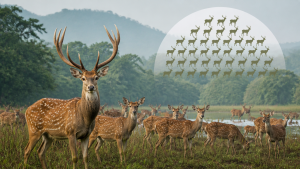
The reintroduced population of hard-ground Barasingha in Satpura Tiger Reserve reached approximately 303 individuals by 10 October 2026. The animals were brought from Kanha National Park under a reintroduction programme initiated by the Madhya Pradesh Forest Department in 2015.
Reintroduction and population growth
Approximately 135 Barasingha were translocated to Satpura between 2015 and 2026. The present population includes successive generations born in the reserve through natural breeding. Translocation is the deliberate movement of wild animals from one location to another for conservation or management purposes. Wildlife reintroductions require suitable habitat, monitoring and measures to support the animals’ survival and breeding.
Population units and habitat connectivity
Three population units have become established across the Satpura landscape. They are associated with the Bori enclosure, Bori grasslands and Malini grasslands in the Churna range. Forest managers are planning corridors to connect at least six grasslands. The proposed network is intended to allow seasonal movement between habitats for forage, water and breeding, and to support demographic and genetic exchange between groups. Habitat connectivity refers to the extent to which landscapes allow animals to move between habitat patches. Corridors can connect separated areas and enable wildlife movement across a wider landscape.
Hard-ground Barasingha
Barasingha, also known as swamp deer, is a deer species found in the Indian subcontinent. The hard-ground Barasingha is associated with central India and is distinct from swamp-dwelling populations through its adaptation to firmer ground. The species’ habitat includes grasslands and wetlands, which provide forage and cover. Grassland condition, availability of water and connections between habitat patches are relevant factors in managing Barasingha populations.
Important Facts for Exams
- The reintroduction programme in Satpura began in 2015 with animals brought from Kanha National Park.
- Approximately 135 Barasingha were translocated to Satpura between 2015 and 2026.
- The Satpura population was estimated at approximately 303 individuals on 10 October 2026.
- The three population units are associated with the Bori enclosure, Bori grasslands and Malini grasslands in the Churna range.
The corridor plan aims to link at least six grasslands in the Satpura landscape. The estimated population comprises animals from both the original translocated group and generations born in the reserve.
| Related | |
|---|---|