Astronomers Identify Green White Dwarf 280 Light-Years Away
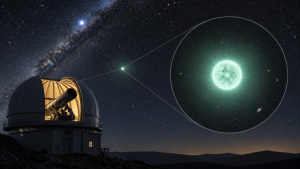
Astronomers have identified WD J1330+6435, a white dwarf that appears chartreuse green to human eyes. It is about 280 light-years from Earth in the constellation Draco. The discovery was announced in October 2026, and the study was led by astrophysicist Mark Hollands of the University of Warwick, England.
White Dwarfs and Stellar Remnants
A white dwarf is the compact remnant left after a star sheds its outer layers at the end of its life. White dwarfs are roughly comparable in size to Earth, although they contain a large fraction of the mass of their original stars. Electron degeneracy pressure supports them against further gravitational collapse. WD J1330+6435 has an estimated surface temperature of about 4,000 degrees Celsius, or 7,232 degrees Fahrenheit. Its chartreuse appearance was derived from spectral data and models of human colour perception, rather than from a direct photograph showing the star as green.
Atmospheric Composition and Stellar Colour
The proposed cause of the star’s colour is the interaction of sodium with helium in its extremely dense atmosphere. This interaction changes the wavelengths of light absorbed by the atmosphere. Sodium, calcium and lithium detected in the star are believed to have come from rocky planetary debris accreted after the star’s planetary system was disrupted. A star’s observed colour is affected by its emitted light and by absorption in its atmosphere. WD J1330+6435’s reported colour therefore relates to its atmospheric composition as well as its surface temperature.
Study and Related White Dwarf
The findings appeared in “RAS Techniques and Instruments”, a journal of the Royal Astronomical Society. The same study identified WD J1011+2845, a white dwarf about 48 light-years away in the constellation Leo Minor. Carbon in its atmosphere is associated with its rare salmon-pink appearance.
Important Facts for Exams
:
- A light-year is a unit of distance equal to the distance light travels in a vacuum in one year.
- Draco and Leo Minor are constellations in the northern celestial hemisphere.
- White dwarfs are stellar remnants, not planets or main-sequence stars.
- Spectroscopy analyses light across different wavelengths to study the composition of astronomical objects.
WD J1330+6435 is located approximately 280 light-years from Earth, while WD J1011+2845 is approximately 48 light-years away. The study was led by Mark Hollands of the University of Warwick.
| Related | |
|---|---|