Astronomers Find Candidate Reborn Planet Around White Dwarf
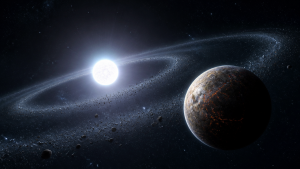
Astronomers have identified a candidate for a second-generation planet orbiting the white dwarf HS 0209+0832. The finding was published in Nature Astronomy on 5 October 2026 and involved researchers from the University of Warwick and the University of Wisconsin-Madison.
White Dwarfs
A white dwarf is the dense remnant of a star that has exhausted its nuclear fuel and shed its outer layers. It is one of the final evolutionary stages of a Sun-like star and has a mass comparable to the Sun compressed into a volume similar to Earth.
Second-Generation Planets
A second-generation planet is a planet that forms after the death of its host star from material left behind or expelled during stellar evolution. The candidate around HS 0209+0832 is described as a “phoenix planet” because it is believed to have formed from matter released during the star’s dying phase.
Detection Methods and Chemical Clues
The evidence includes an unusual chemical signature in the white dwarf’s atmosphere. Zinc, copper, and niobium were detected at levels more than 1,000 times higher than in the Sun. The pattern is linked to the s-process, or slow neutron-capture process, which occurs inside dying stars.
Important Facts for Exams
- HS 0209+0832 is a white dwarf, which is the compact remnant of a star after the red giant phase.
- NASA’s Transiting Exoplanet Survey Satellite, or TESS, is used to detect exoplanets through periodic dips in stellar brightness.
- The candidate planet has an orbital period of about 4.4 Earth days and is estimated to be Jupiter-sized.
- The Sun is expected to become a white dwarf in several billion years after leaving the main sequence.
Exoplanet Research Context
Exoplanets are planets outside the Solar System, and they are detected through methods such as transit photometry and radial velocity measurements. White dwarf systems are studied to understand planetary survival, planetary re-formation, and the long-term evolution of planetary systems. The discovery adds a candidate example of a planet associated with a post-stellar environment. It also places white dwarf HS 0209+0832 in the study of planetary system evolution after stellar death.
| Related | |
|---|---|