IISc Maps 9,389 Reactions in CO₂-to-Fuel Modelling
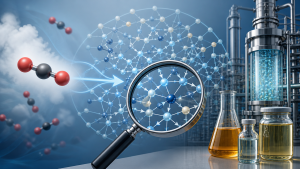
Researchers at the Indian Institute of Science (IISc), Bengaluru, developed a computational framework that maps 9,389 elementary chemical reactions involved in carbon dioxide (CO₂) conversion into fuels and chemicals. The study was published in Nature Communications on 6 October 2026 and focuses on CO₂ hydrogenation on a copper catalyst.
CO₂ Hydrogenation
CO₂ hydrogenation is a catalytic process in which carbon dioxide reacts with hydrogen to form products such as methanol and carbon monoxide. Copper-based catalysts are widely studied in this field because they support multiple reaction pathways in CO₂ conversion chemistry.
Computational Methods Used
The IISc framework combines quantum-mechanical simulations, machine learning, automated reaction discovery, and kinetic modelling. These methods were used to build a detailed reaction network for tracking elementary steps in CO₂-to-fuel conversion.
Reaction Network and Product Prediction
Earlier models considered 152 reactions and predicted formic acid as the main product. The expanded network of 9,389 reactions predicted about 40-fold higher CO₂ conversion and identified methanol and carbon monoxide as the major products, matching experimental observations.
Important Facts for Exams
- Carbon dioxide is a linear molecule with the formula CO₂ and one carbon atom bonded to two oxygen atoms.
- Methanol has the chemical formula CH₃OH and is used as a fuel and industrial feedstock.
- Carbon monoxide has the chemical formula CO and is an important intermediate in synthesis gas chemistry.
- Nature Communications is a peer-reviewed journal published by Springer Nature.
Reaction Pathways and Future Use
The model identified a hydrogen-transfer pathway in which molecular hydrogen (H₂) can transfer directly to reaction intermediates in some steps. The researchers stated that the framework can be adapted for CO₂ reduction with other catalysts, nitrogen reduction, and water splitting.
| Related | |
|---|---|