Astrobase Unveils India’s First Private 800 kN Rocket Engine
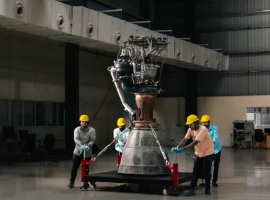
Bengaluru-based Astrobase Space Technologies unveiled EVEREST on 7 August 2026 as India’s first privately built 80-tonne-class Full-Flow Staged Combustion rocket engine. The engine uses liquid oxygen and liquid methane, produces 800 kilonewtons of thrust, and is designed for reusable medium-lift launch vehicles.
Full-Flow Staged Combustion Engine
Full-Flow Staged Combustion, or FFSC, is a liquid rocket engine cycle in which both propellants pass through preburners before entering the main combustion chamber. The cycle is used in high-performance engines and is associated with higher efficiency and lower thermal stress than simpler engine cycles.
Technical Features of EVEREST
EVEREST has a specific impulse of about 340 seconds and a throttle range from 50% to 110%. The engine is intended for reusable launch systems, where controlled thrust variation is required during ascent, landing, and recovery operations.
Development, Testing and Manufacturing
Astrobase was selected under IN-SPACe’s Technology Adoption Fund on 10 June 2026 for indigenous development of the 800 kN LOX-methane engine. The company completed sub-scale hot-fire tests in September 2025 and turbopump trials in January 2026, while full-scale hot-fire tests were scheduled for later in 2026.
The startup was founded in 2024 by former ISRO propulsion engineer Devakumar Thammisetty and CoinDCX co-founder Neeraj Khandelwal. Its Bengaluru facility covers 46,000 square feet and uses India’s largest industrial metal 3D printer for core components, while its propulsion test facility in Anantapur, Andhra Pradesh, spans 21.5 acres.
Important Facts for Exams
- Liquid oxygen is commonly written as LOX, and liquid methane is used as a cleaner-burning rocket fuel in several modern launch vehicle designs.
- Specific impulse is a standard measure of rocket engine efficiency and is expressed in seconds.
- Thrust is measured in newtons, and 800 kilonewtons equals 800,000 newtons.
- Reusable launch vehicles are designed to recover and fly again, which requires engine throttling and restart capability.
India’s Private Space Sector
IN-SPACe is the regulatory and promotional body for private space activities in India under the Department of Space. Private firms in India develop launch vehicles, propulsion systems, satellites, and ground infrastructure under the country’s space sector reforms.
| Related | |
|---|---|