
AIDS in India
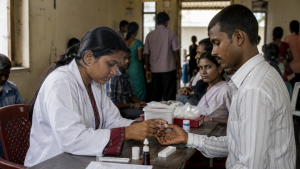
HIV causes AIDS by damaging the immune system and increasing vulnerability to infections and certain cancers. India’s response developed from early case detection in 1986 into a national programme led by the National AIDS Control Organisation (NACO).
HIV and Transmission
Human immunodeficiency virus (HIV) is a retrovirus. It has also been referred to as human T-lymphotropic virus-III (HTLV-III), lymphadenopathy-associated virus (LAV) and AIDS-associated retrovirus (ARV). HIV infection can progress to acquired immune deficiency syndrome (AIDS), in which the immune system is severely weakened. Transmission can occur through anal, vaginal or oral sex; transfusion of infected blood; and use of contaminated hypodermic needles. The virus can also pass from mother to child during pregnancy, childbirth or breastfeeding. Exposure to infected bodily fluids is central to the routes described above.
Effects of AIDS
Because HIV damages elements of the immune system, a person with AIDS becomes vulnerable to infections caused by bacteria, viruses, fungi and parasites that a healthy immune system would normally control. These are known as opportunistic infections. HIV can affect nearly every organ system. People with AIDS may develop cancers including Kaposi’s sarcoma, cervical cancer and lymphomas, which affect the immune system. Common systemic symptoms include fever, night sweats, swollen glands, chills, weakness and weight loss. The particular infections, cancers and symptoms can vary between individuals.
Historical Global Burden
The figures in the source article describe the global epidemic in the period up to 2007, not current prevalence. They record the scale of the disease during that period:
- About 33.2 million people were living with AIDS worldwide in 2007.
- An estimated 2.1 million people died of AIDS that year, including 330,000 children.
- About 75% of the reported deaths were in sub-Saharan Africa.
- More than 25 million people had died of AIDS between 1981 and 2007.
Early HIV Response in India
India’s first HIV cases were diagnosed among sex workers in Chennai in 1986. After the first AIDS case was detected in the country, the National AIDS Committee was constituted in the Ministry of Health and Family Welfare. By the end of the 1980s, HIV spread was also observed among injecting drug users (IDUs) in Manipur, Mizoram and Nagaland. The need for a nationwide programme led to the launch of the first National AIDS Control Programme (NACP-I) in 1992 and the establishment of NACO to implement it. NACO is a division of the Ministry of Health and Family Welfare and provides leadership for India’s HIV/AIDS control programme. The source describes its work through 35 HIV/AIDS Prevention and Control Societies. In 1992, the government also set up State AIDS bodies in 25 states and seven Union Territories. State AIDS Cells were created within the Directorates of Health Services, helping build programme capacity at state and Union Territory levels.
National AIDS Control Programmes
NACP-I, 1992–1999
The primary objective of NACP-I was to control the spread of HIV infection. Its measures included strengthening blood safety, addressing sexually transmitted diseases (STDs), beginning surveillance and raising public awareness.
- Services: The programme established 685 blood banks and 504 STD clinics.
- Surveillance: An HIV sentinel surveillance system was initiated.
- Prevention: NGOs were involved in interventions focused on awareness generation.
NACP-II, 1999–2006
NACP-II expanded the programme and introduced targeted interventions through NGOs. These focused on high-risk groups (HRGs), including commercial sex workers (CSWs), men who have sex with men (MSM) and IDUs, as well as bridge populations such as truckers and migrants. Behaviour Change Communication, STD management and condom promotion were incorporated.
- Testing and treatment: Voluntary counselling and testing facilities were established, and free antiretroviral therapy began in selected hospitals.
- Education: A School AIDS Education Programme was developed. Teachers and peer educators were trained to engage students through active learning.
- Policy: Initiatives included the National AIDS Prevention and Control Policy and the National Blood Policy.
- Research: Development of an indigenous vaccine and research on microbicides were among the HIV research initiatives.
The programme ended in March 2006. AIDS control societies also received support for youth campaigns, blood safety checks and HIV testing.
Public Awareness and Outreach
The government used public platforms to communicate information about HIV/AIDS, including concerts, radio dramas, television spots and a voluntary blood donation day. School-based communication included teacher and peer-educator training, debates and role-play activities. On World AIDS Day in 2007, India launched the Red Ribbon Express (RRE), a seven-coach train for HIV/AIDS education and awareness. During its one-year journey, it travelled across 24 states, stopped at 180 stations and covered more than 27,000 km. The campaign reached around 6.2 million people. The source describes it as the world’s largest social mobilisation campaign against HIV/AIDS by UNICEF. The train returned to New Delhi on 1 December, World AIDS Day. Condom promotion was another focus of the awareness effort. The government supported the installation of more than 11,000 condom vending machines in colleges, roadside restaurants, stations, petrol stations and hospitals. With support from the United States Agency for International Development (USAID), it also initiated the “Condom Bindas Bol!” campaign, using advertising, public events and celebrity endorsements to challenge embarrassment around buying condoms. In West Bengal, health activists promoted condom use through kite flying ahead of Durga Puja.
Key Prelims Takeaways
- Virus: HIV is a retrovirus that causes AIDS by weakening the immune system.
- Early detection: India’s first HIV cases were diagnosed among sex workers in Chennai in 1986.
- National response: NACP-I began in 1992, with NACO established to implement the programme.
- NACP-I: Its stated objective was to control the spread of HIV infection.
- NACP-II: It expanded targeted interventions, testing, education and treatment initiatives.
- Red Ribbon Express: Launched on World AIDS Day in 2007, it reached around 6.2 million people.
Anonymous
September 1, 2009 at 10:20 amexcellent job Sir
aaruhi joshi
December 3, 2014 at 7:20 amGreat job