Aditya-L1 and Proba-3 Study Solar Eruptions
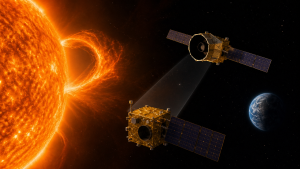
On 16 October 2026, India’s Aditya-L1 mission and the European Space Agency’s (ESA) Proba-3 mission combined observations of solar eruptions. Data from Aditya-L1’s Visible Emission Line Coronagraph (VELC) and Proba-3’s ASPIICS instrument were used to measure the mass, density and energy of coronal mass ejections (CMEs) near the Sun.
Solar Flares and Coronal Mass Ejections
Solar flares are sudden releases of energy from the Sun’s atmosphere, while CMEs are large expulsions of plasma and magnetic field from the solar corona. Both phenomena can affect space weather and Earth’s near-space environment. In 2026, an Aditya-L1 study identified small, short-lived brightenings in the solar atmosphere hours before major flares; these brightenings clustered around the eventual flare site. Researchers from the Manipal Centre for Natural Sciences, Manipal Academy of Higher Education, ISRO and the Department of Space conducted the study. On 23 July 2026, Aditya-L1 observations were reported to include a comprehensive analysis of photospheric iron fluorescence across 47 X-class flares during the 2024 peak of Solar Cycle 25. The observations also provided spectroscopic signatures of the onset phase of a CME.
Aditya-L1 and Solar Observation
Aditya-L1 is India’s first dedicated solar mission. ISRO launched it on 2 September 2023, and the spacecraft entered a halo orbit around the Sun–Earth L1 point on 6 January 2024. A halo orbit around L1 provides a continuous view of the Sun. L1 is the first of five Lagrange points in the Sun–Earth system.
Proba-3 and Formation Flying
ESA’s Proba-3 is a two-spacecraft mission launched by ISRO’s PSLV-XL rocket on 5 December 2024. Its spacecraft fly in precise formation to create artificial solar eclipses, allowing observations of the faint corona. On 1 January 2026, ESA confirmed that the mission had achieved autonomous formation flying with millimetre-level precision. By 17 December 2025, it had produced more than 50 artificial eclipses and over 250 hours of high-resolution coronal video.
Important Facts for Exams
- Proba-3’s ASPIICS instrument observes the solar corona using an artificial eclipse created by the spacecraft formation.
- Aditya-L1 carries the Visible Emission Line Coronagraph, designed to observe the solar corona.
- Proba-3’s first scientific results, published in March 2026, found inner-corona solar-wind structures travelling three to four times faster than earlier estimates.
- ISRO and ESA held a solar-science workshop at the Indian Institute of Space Science and Technology in Thiruvananthapuram from 19 to 23 January 2026.
The Solar Orbiter mission also contributed complementary data presented at the January 2026 workshop. Aditya-L1 and Proba-3 use different observing approaches to study the Sun’s corona and related solar activity.
| Related | |
|---|---|