Indus Valley Civilization: Sites, Features and Chronology
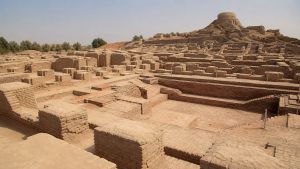
The Indus Valley Civilization was one of the earliest urban cultures of the ancient world, centered on the Indus and Ghaggar-Hakra river systems. It is known for planned cities, standardized material culture, sophisticated drainage, seals, and wide trade links.
Archaeological evidence from India, Pakistan, and Afghanistan shows a long developmental history from early village settlements to mature urban centers and later regional de-urbanization.
Chronological Framework and Phases
- Early Harappan Phase (c. 3300–2600 BCE): This was the formative stage of urbanism. Excavations and radiocarbon dating show earlier urban occupation at Mohenjo-daro during the Kot Diji Phase.
- Mature Harappan Phase (c. 2600–1900 BCE): This was the peak urban phase, marked by well-planned cities, standardized weights, uniform burnt-brick ratios, and the widespread use of the Harappan script.
- Late Harappan Phase (c. 1900–1300 BCE): This phase saw gradual decline and de-urbanization. Many urban centers weakened, and populations moved eastward and southward into regional post-urban chalcolithic cultures.
Major Urban Settlements and Key Sites
- Rakhigarhi (Haryana): Spread over about 550 hectares in the Ghaggar-Hakra river valley, it is the largest known Harappan settlement.
- Mohenjo-daro (Pakistan): Located on the Indus River, it is famous for the Great Bath and the Great Granary. Recent excavations of the massive mudbrick perimeter wall show that it was built in phases.
- Lothal (Gujarat): A major maritime site on the Bhogavo River, known for its brick basin identified as a tidal dockyard, bead-making industry, and double burials.
- Kunal (Haryana): In Fatehabad district, this site shows three occupational phases covering pre-, early-, and mature Saraswati-Indus cultural stages.
- Sinauli (Uttar Pradesh): Dated to c. 2000–1800 BCE, it belongs to the Late Bronze Age Ochre Coloured Pottery/Copper Hoard culture and has yielded wooden coffin burials, copper weapons, and solid-disk wheel carts.
- Tilwara (Uttar Pradesh): About 10 km from Sinauli, excavations revealed a 4,500-year-old Copper Age burial site with a copper-plated cart and a coffin-like structure.
Material Culture, Economy and Technologies
- Standardized weights and measures: The Harappans used a precise dual system of measurement. Lower denominations followed a binary pattern, while higher weights followed a decimal system, often using polished chert blocks.
- Seals and script: More than 2,000 steatite seals have been found, with animal motifs such as the unicorn, humped bull, and rhinoceros. The script remains undeciphered.
- Metallurgy: Harappans worked with copper, bronze, gold, and silver. They used the lost-wax technique, and the bronze figure known as the Dancing Girl is a well-known example.
- Transport: Solid-wheel vehicles from Sinauli are generally identified as ox-pulled carts or funeral carts, not horse-drawn chariots, since no horse remains were found there.
- Brick technology: Standard baked bricks with the ratio of 4:2:1 were used widely in major urban settlements, reflecting strong planning and standardization.
Comparative Features of Important Sites
| Site | State/Region | Associated River | Major Findings |
| Harappa | Punjab (Pakistan) | Ravi | Six granaries, wooden coffin burial, sandstone male torso |
| Kalibangan | Rajasthan | Ghaggar | Ploughed field surface, wooden furrow, fire altars, camel bones |
| Dholavira | Gujarat | Luni (Rann of Kutch) | Water harvesting system, stadium, ten-alphabet signboard |
| Banawali | Haryana | Saraswati (dry bed) | High-quality barley, terracotta plough model, oval settlement |
| Chanhudaro | Sindh (Pakistan) | Indus | Only city without a citadel, bead-making factory, dog chasing cat footprint |
Burials, Town Planning and Other Core Features
- Burial practices: Harappans used complete, fractional, and urn burials. Wooden coffin burials are known from Harappa and Sinauli.
- Town planning: Cities typically had a raised western citadel for administrative and public buildings and a lower eastern town for residential quarters.
- Drainage: Advanced drainage networks were a defining urban feature and show careful civic planning.
- Trade: The civilization had extensive internal and maritime trade, supported by standardized goods, seals, and weights.
- Script: The Harappan script is generally written in a right-to-left direction; in some cases, the direction may alternate.
- Material uniformity: The repeated use of standardized tools, seals, bricks, and weights points to strong administrative cohesion.
Key Prelims Takeaways
- Rakhigarhi is the largest known Harappan settlement, larger than Mohenjo-daro.
- Mature Harappan Phase (c. 2600–1900 BCE) was the urban peak of the civilization.
- Harappan town planning usually featured a citadel and a lower town.
- Standardized baked bricks followed the 4:2:1 ratio.
- Iron was not known to the Indus Valley people; they used copper and bronze.
- Lothal is important for its dockyard and maritime trade evidence.
- Kalibangan is known for the ploughed field, fire altars, and camel bones.
Current General Studies comprises current-affairs-based, General Studies-rich study material on policies, laws, institutions, economy, science, environment, governance, international relations, and other varied but important topics for UPSC and State PSC Prelims examinations.
Fortnightly PDF compilations: Available here
Originally written on
February 12, 2026
and last modified on
September 4, 2026.
| Related | |
|---|---|