Structure and Functions of Subordinate Courts in India
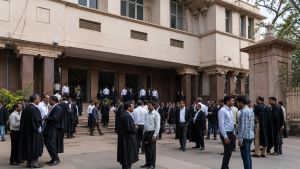
Subordinate courts form the foundational tier of India’s judiciary, handling most civil and criminal disputes at district and local levels. Their constitutional framework, court hierarchy and jurisdiction shape access to justice, judicial capacity and the resolution of case pendency.
Constitutional Framework
- Article 233: The Governor appoints, posts and promotes District Judges in consultation with the High Court exercising jurisdiction over the State.
- Article 234: Appointments of persons other than District Judges to the State judicial service are made by the Governor under rules framed after consultation with the State Public Service Commission and the High Court.
- Article 235: The High Court controls District Courts and courts subordinate to them, including matters concerning the posting, promotion and grant of leave to judicial officers.
- Article 236: “District Judge” includes, among others, a Sessions Judge, Additional Sessions Judge, Assistant Sessions Judge and Chief Judge of a Small Cause Court. “Judicial service” comprises persons intended to fill the post of District Judge and other civil judicial posts inferior to it.
Criminal Court Hierarchy and Sentencing Powers
The source framework for criminal courts is the Code of Criminal Procedure (CrPC), 1973. Criminal courts at district level range from the Court of Sessions to courts of Judicial Magistrates.
- Court of Sessions: It is the highest criminal court in a district and is presided over by a Sessions Judge. Additional Sessions Judges and Assistant Sessions Judges may also preside over courts under the Sessions Judge.
- Sessions Judge: A Sessions Court may pass any sentence authorised by law, including a death sentence. A death sentence requires confirmation by the High Court before it can be executed.
- Assistant Sessions Judge: May impose imprisonment for a term not exceeding ten years, a fine, or both.
- Chief Judicial Magistrate (CJM): The High Court appoints a CJM in every district. A CJM may impose any sentence authorised by law except death, imprisonment for life or imprisonment exceeding seven years.
- Judicial Magistrates: A Judicial Magistrate First Class may impose imprisonment up to three years, a fine up to Rs 10,000, or both. A Judicial Magistrate Second Class may impose imprisonment up to one year, a fine up to Rs 5,000, or both.
- Executive Magistrates: District Magistrates, Sub-Divisional Magistrates and other Executive Magistrates perform primarily preventive and administrative functions, including maintaining law and order; they are distinct from the judicial magistracy.
Civil Court Hierarchy
Civil courts generally follow the framework of the Code of Civil Procedure (CPC), with pecuniary and territorial limits shaped by State laws and applicable High Court rules.
- District Court: Presided over by a District Judge, it is the highest civil court in the district and hears civil matters within its jurisdiction. Additional District Judges may assist the District Judge.
- Senior Division: Courts of Civil Judge (Senior Division), also called Subordinate Judges in some States, deal with civil cases involving higher pecuniary values than those handled by junior courts.
- Junior Division: Courts of Civil Judge (Junior Division), also known as Munsiff courts, hear cases of smaller pecuniary value. Their jurisdiction varies among States.
- Small Causes Courts: Established in certain areas to provide quicker disposal of civil cases of small value. They generally do not try cases involving title to immovable property.
- Nyaya Panchayats: These village-level bodies provide informal local dispute resolution and have limited civil and criminal jurisdiction. They are not present in all States.
Appointments, Functions and Judicial Administration
- Appointment of District Judges: The Governor makes appointments in consultation with the High Court, as provided by Article 233.
- Other judicial officers: Recruitment is generally through competitive examinations conducted by the State Public Service Commission in consultation with the High Court, in accordance with Article 234 and applicable rules.
- Service conditions: State service rules govern matters such as promotion, leave and retirement age, subject to constitutional provisions and judicial directions. The High Court’s control under Article 235 supports judicial independence and administrative supervision.
- Original jurisdiction: Subordinate courts are the courts of first instance for most civil and criminal cases arising within their territorial limits. They conduct trials under the Indian Penal Code and other applicable laws, and adjudicate civil disputes.
- Appeals and enforcement: District Courts hear appeals from lower civil and criminal courts within their jurisdiction. Subordinate courts also execute decrees and orders passed by themselves and, where assigned, by higher courts.
- Magisterial work: Judicial Magistrates conduct preliminary inquiries, take cognizance of offences and issue summons and warrants as provided by law.
- Access and capacity: These courts bring dispute resolution closer to communities and carry a major share of the judicial workload. Adequate judicial capacity and timely disposal are important to improving access to justice and addressing case pendency.
- Retirement age: The Supreme Court’s 2002 decision in All India Judges’ Association v. Union of India set the subordinate judiciary’s retirement age at 60 years, subject to assessment of an officer’s suitability for continued service. Any extension is conditional on High Court assessment of suitability and performance, not automatic.
Key Prelims Takeaways
- Article 233: Appointment, posting and promotion of District Judges by the Governor in consultation with the High Court.
- Article 235: Control over District Courts and subordinate courts is vested in the High Court.
- Article 234: Covers appointments to the State judicial service other than District Judges.
- Criminal and civil procedure: The source frameworks are the CrPC, 1973, and the CPC, respectively.
- Sessions Court: Highest criminal court in a district; a death sentence requires High Court confirmation.
- Retirement: The 2002 All India Judges’ Association decision set the age at 60, subject to suitability assessment; extensions require High Court assessment.
Recent Context
On October 26, 2026, the Supreme Court said 14 States had agreed to raise District Judicial Officers’ retirement age from 60 to 62, following its September 4 direction. The States must amend their rules; meanwhile, continuation is subject to High Court assessment. Eligible officers who retired from March 31, 2026, in seven named States may rejoin if they have not taken other employment.
| Related | |
|---|---|