Sources and Mechanisms of MSME Finance in India
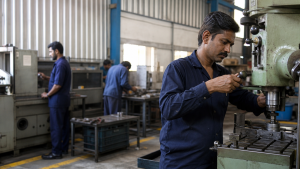
Micro, Small and Medium Enterprises (MSMEs) rely on a mix of institutional lending, government-backed credit support and digital finance. Understanding these channels—including guarantees and invoice financing—helps explain how India seeks to improve credit access for smaller businesses.
MSME Classification and Economic Role
India classifies MSMEs using a composite criterion of investment in plant and machinery or equipment and annual turnover. The revised limits took effect on April 1, 2025, removing the earlier distinction between manufacturing and service enterprises.
- Micro enterprise: Investment up to ₹2.5 crore and turnover up to ₹10 crore.
- Small enterprise: Investment up to ₹25 crore and turnover up to ₹100 crore.
- Medium enterprise: Investment up to ₹125 crore and turnover up to ₹500 crore.
As of January 2026, the sector contributed approximately 31.1% of India’s GDP, 35.4% of manufacturing output and 48.58% of merchandise exports. It employed more than 38.9 crore people, making it the country’s second-largest source of employment after agriculture. These figures underline why timely working capital and investment finance matter to both production and employment.
Institutional Financial Ecosystem
MSME finance is supplied by institutions with different lending models and customer bases. Together, they provide working capital, term finance and other credit facilities, although access and terms can vary with the borrower’s size, location and credit profile.
- Commercial banks: Public and private sector banks are primary lenders, offering working capital loans, term loans and other credit facilities.
- Small Finance Banks: SFBs focus on financial services for unserved and underserved groups, including MSMEs.
- Non-Banking Financial Companies: NBFCs help bridge the credit gap and may offer more flexible lending solutions.
- Microfinance Institutions: MFIs serve micro-enterprises and self-help groups, particularly in rural and semi-urban areas.
A broad lender base supports financial inclusion, but access to finance remains linked to the ability to document business activity and demonstrate repayment capacity. Government guarantees and digital platforms complement direct lending by addressing credit risk and liquidity constraints.
Government Credit Support and Schemes
Government initiatives support credit flow through guarantees, assistance for enterprise creation and broader reforms to MSME performance.
- Credit Guarantee Scheme for Micro and Small Enterprises: The scheme, implemented through the Credit Guarantee Fund Trust for Micro and Small Enterprises (CGTMSE), was established by the Ministry of MSME and SIDBI. It provides guarantees to eligible Member Lending Institutions for collateral-free credit to Micro and Small Enterprises. The ceiling for qualifying credit facilities rose to ₹10 crore from April 1, 2025.
- Support for women-led enterprises: Under the scheme, guarantee coverage can reach 90% for women-led enterprises, with a 10% concession on the guarantee fee. By February 2026, around 30.75 lakh guarantees worth approximately ₹2.07 lakh crore had been approved for women-owned enterprises.
- Prime Minister’s Employment Generation Programme: PMEGP supports self-employment by assisting in the establishment of micro-enterprises in non-farm sectors.
- Pradhan Mantri Mudra Yojana: PMMY provides collateral-free loans up to ₹10 lakh to non-corporate, non-farm small and micro enterprises.
Raising and Accelerating MSME Performance (RAMP) is a World Bank-backed Central Sector Scheme of the Ministry of MSME. Launched on June 30, 2022, it runs from FY 2022-23 to FY 2026-27. Its overall outlay is ₹6,062.45 crore (USD 808 million), including a World Bank loan component of USD 500 million. RAMP supports reforms to improve MSME performance, strengthen credit guarantees for women-owned micro and small enterprises, and enhance receivables financing. It aims to benefit 5.5 lakh MSMEs; more than 4 lakh have been impacted so far.
Digital Finance and TReDS
The Trade Receivables Discounting System (TReDS) is an RBI-regulated digital platform through which businesses, particularly MSMEs, can obtain finance against unpaid invoices. Invoice discounting converts a receivable due at a later date into funds available earlier, helping sellers manage working capital without waiting for the buyer’s payment.
- RAMP support: RAMP has allocated USD 436 million to initiatives related to TReDS. As of October 2026, it had helped more than 2.5 lakh MSMEs access capital faster through the platform.
- Registered sellers: MSME sellers registered on TReDS reached 2.46 lakh by May 2026.
- Platform participation: By June 2026, the platform had 78 financiers and more than 13,000 active buyers.
- NBFC participation: Thirty NBFCs had joined TReDS as of October 2026.
TReDS illustrates how digital financial inclusion can widen access to invoice financing. Its effectiveness also depends on participation by buyers, financiers and sellers, alongside suitable financial regulation and reliable platform processes.
International Support and Private Capital
The World Bank Group comprises five institutions: the International Bank for Reconstruction and Development (IBRD), International Development Association (IDA), International Finance Corporation (IFC), Multilateral Investment Guarantee Agency (MIGA), and International Centre for Settlement of Investment Disputes (ICSID).
- IFC: Provides financing and advisory services to private-sector businesses in developing countries.
- MIGA: Offers political risk insurance and credit enhancement to investors and lenders. IFC and MIGA guarantees have been used to attract institutional investors to projects in India.
- Women-owned businesses: Credit guarantees for women-owned businesses increased from 14% to 18% over two years, generating more than USD 1 billion, according to figures available in October 2026. Approximately 3.69 crore registered MSMEs were women-owned, around 38% of registrations.
Key Prelims Takeaways
- MSME classification combines investment and turnover limits; the revised definition took effect on April 1, 2025.
- As of January 2026, MSMEs contributed 31.1% of GDP and 48.58% of merchandise exports.
- CGTMSE-backed collateral-free credit facilities have a guarantee ceiling of ₹10 crore.
- Women-led enterprises can receive up to 90% guarantee coverage and a 10% guarantee-fee concession.
- RAMP is a Ministry of MSME Central Sector Scheme running from FY 2022-23 to FY 2026-27.
- TReDS is an RBI-regulated platform for financing trade receivables through invoice discounting.
Recent Context
The World Bank Group mobilised a cumulative USD 36 billion in private capital for India over four years, including USD 9.6 billion for MSMEs. Mobilisation rose from approximately USD 3 billion in FY22 to USD 14.5 billion in FY26, according to Manuel Reyes-Retana, IFC Division Director for South Asia.
| Related | |
|---|---|