States PCS: Gujarat GK Questions for GPSC Exams
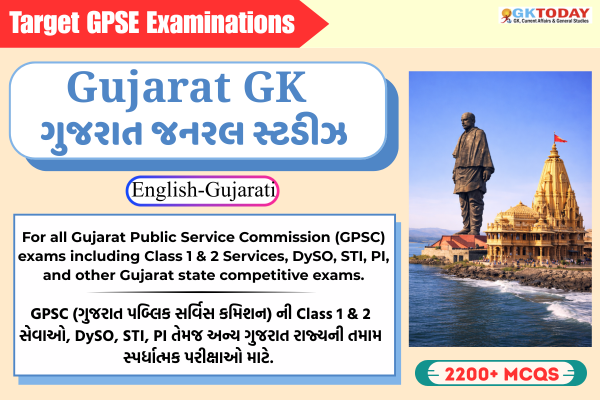
For all Gujarat Public Service Commission (GPSC) exams including Class 1 & 2 Services, DySO, STI, PI, and other Gujarat state competitive exams.
1. Which dynasty governed Sindh and parts of Kutch from 1701 to 1783?
[A] Kalhora dynasty
[B] Talpur dynasty
[C] Soomra dynasty
[D] Arghun dynasty
Show Answer
Correct Answer: A [Kalhora dynasty]
Notes:
The Kalhora dynasty, a Sindhi Muslim tribe, ruled Sindh and parts of Kutch (now Gujarat) from 1701-1783, with capitals at Khudabad and Hyderabad. They were Mughal-appointed subedars, became Durrani vassals, and were succeeded by the Talpurs.
2. Which dynasty, established by Bhaṭārka, governed Western India between 475 and 776 CE?
[A] Gupta Dynasty
[B] Chalukya Dynasty
[C] Maitraka Dynasty
[D] Rashtrakuta Dynasty
Show Answer
Correct Answer: C [Maitraka Dynasty]
Notes:
Maitraka dynasty, founded by Bhaṭārka, ruled Western India (475–776 CE) from Vallabhi; known for Vallabhi University and patronage of Hinduism, Buddhism, and Jainism.
3. Who were the Brahmin priests of South Gujarat known for narrating Akhyanas with musical accompaniment using a copper water pitcher (man)?
[A] Charanas
[B] Bhats
[C] Garasiya
[D] Manbhatt
Show Answer
Correct Answer: D [Manbhatt]
Notes:
Manbhatt were Brahmin priests of south Gujarat narrating Akhyanas with music using a copper water pitcher (man). Charanas and Bhats composed epic verses in forms like doha, soratha, and chhand. They performed stories from epics and Puranas with rhythmic musical accompaniment.
4. Who were the two prominent Maratha leaders responsible for expelling Mughal nobles from Gujarat in the mid-18th century?
[A] Shivaji and Sambhaji
[B] Raghunathrao and Madhavrao
[C] Gaikwar and Peshwa
[D] Tanaji Malusare and Bajirao I
Show Answer
Correct Answer: C [Gaikwar and Peshwa]
Notes:
The Marathas, led by Gaikwar and Peshwa, expelled Mughal nobles from Gujarat by mid-18th century. Key events include the capture of Ahmedabad (1756-58), British East India Company taking Surat (1759), and Maratha consolidation post-Third Battle of Panipat (1761), ending Mughal rule.
5. Who was the founder of Amul, the dairy cooperative established in 1946 that played a pivotal role in India’s White Revolution?
[A] Verghese Kurien
[B] Morarji Desai
[C] Tribhuvandas Patel
[D] Vallabhbhai Patel
Show Answer
Correct Answer: C [Tribhuvandas Patel]
Notes:
Tribhuvandas Patel founded Amul in Anand, Gujarat in 1946, pioneering the cooperative movement behind India’s White Revolution and the Anand pattern of dairy cooperatives.
6. Which merchant is credited with building one of the ancient Harsiddhi temples in Miyani, Gujarat, during the 13th century?
[A] Jagdusha
[B] Virji Vora
[C] Shantidas
[D] Premchand Roychand
Show Answer
Correct Answer: A [Jagdusha]
Notes:
Miyani, a beach village in Porbandar Taluka, Gujarat, is a fishing center on the Arabian Sea coast. It is a Hindu and Jain pilgrimage site with ancient Harsiddhi temples, including one built by Jain merchant Jagdusha in the 13th century.
7. In which district of Gujarat was the renowned poet-saint Narsinh Mehta born?
[A] Ahmedabad
[B] Bhavnagar
[C] Surat
[D] Rajkot
Show Answer
Correct Answer: B [Bhavnagar]
Notes:
Narsinh Mehta, the 15th-century poet-saint and ‘Adi Kavi’ of Gujarati literature, was born in Talaja, Bhavnagar district, Gujarat. He is renowned for his devotional compositions and pioneering contributions to Gujarati literature.
8. Who was the first Indian from Gujarat to be elected to the British Parliament?
[A] Mohandas Karamchand Gandhi
[B] Sardar Vallabhbhai Patel
[C] Dadabhai Naoroji
[D] Jivraj Mehta
Show Answer
Correct Answer: C [Dadabhai Naoroji]
Notes:
Dadabhai Naoroji, from Gujarat, was the first Indian elected to the British Parliament, serving as MP for Finsbury Central (1892-1895) and advocating Indian rights and self-governance.
9. Which river is spanned by the Golden Bridge near Bharuch in Gujarat?
[A] Tapi River
[B] Mahi River
[C] Narmada River
[D] Sabarmati River
Show Answer
Correct Answer: C [Narmada River]
Notes:
The Golden Bridge over the Narmada River near Bharuch was constructed in 1881 during British rule and spans the river, connecting Bharuch and Ankleshwar.
10. Vadnagar, famous for the ancient Hatkeshwar Mahadev Temple, is situated in which district of Gujarat?
[A] Mehsana
[B] Ahmedabad
[C] Surat
[D] Rajkot
Show Answer
Correct Answer: A [Mehsana]
Notes:
Vadnagar, in Mehsana district, is known for the ancient Hatkeshwar Mahadev Temple, a significant Shaiva shrine, and the intricately carved Kirti Toran archway, reflecting its rich archaeological and architectural heritage.