New Legless Amphibian Discovered in Maharashtra
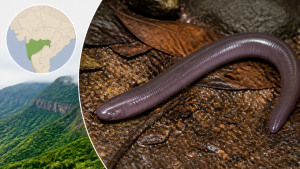
Gegeneophis chandgadi is a newly described subterranean, legless amphibian, also called a caecilian, from Buzawade village in Chandgad tehsil of Kolhapur district, Maharashtra. The species was formally published in the Records of the Zoological Survey of India on 2 September 2026 and belongs to the genus Gegeneophis, which includes Indian caecilians from the Western Ghats.
Caecilians as Amphibians
Caecilians are limbless amphibians in the order Gymnophiona. They are adapted for burrowing and live mostly underground in moist soil, leaf litter, or near streams in tropical regions.
Unlike frogs and salamanders, caecilians have elongated, cylindrical bodies and reduced or absent external limbs. Their eyes are often small and may be covered by skin or bone in some species.
Diagnostic Features of Gegeneophis chandgadi
Gegeneophis chandgadi is described as worm-like and flesh-coloured. It has primary body rings along the full length of the body and secondary rings on the posterior half.
These ring-like folds are called annuli and are used in the identification of caecilian species. The species was named after the Chandgadi dialect of Marathi spoken in the region.
Western Ghats and Indian Herpetofauna
The Western Ghats is a biodiversity hotspot in India and a major centre for amphibian diversity. Maharashtra, Karnataka, Kerala, Tamil Nadu, and Goa contain parts of this mountain chain.
India has several endemic caecilian species, and many are recorded from the Western Ghats. The genus Gegeneophis is one of the Indian caecilian groups known from this region.
Important Facts for Exams
- Caecilians belong to the amphibian order Gymnophiona.
- Caecilians are legless and are adapted for a fossorial, or burrowing, life.
- The Western Ghats is recognised as a global biodiversity hotspot.
- The Records of the Zoological Survey of India is a scientific publication linked to the Zoological Survey of India.
Related Taxonomic Context
Gegeneophis valmiki is another caecilian species from Maharashtra, announced from the Valmiki Plateau in Satara district in 2026. It was described as a blind caecilian with eyes hidden beneath bone.
The first specimen of Gegeneophis valmiki was collected in 2017 by researchers of the Zoological Survey of India.
| Related | |
|---|---|