Nepal Flash Floods Hit Bhote Koshi and Trishuli Rivers
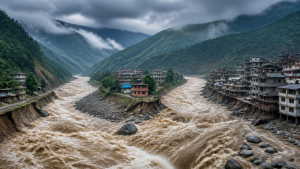
A sudden flash flood swept through Nepal’s Bhote Koshi and Trishuli river systems on 26 August 2026. The flood affected the Rasuwa, Nuwakot and Dhading districts, and it caused deaths, missing-person cases, damage to roads and bridges, and disruption to cross-border movement.
Geographical Setting of the Flood-Prone Region
The Bhote Koshi and Trishuli rivers are part of the Himalayan river network in central Nepal. The affected districts of Rasuwa, Nuwakot and Dhading lie in a mountainous zone where steep slopes, narrow valleys and glacial or snow-fed streams can increase flood velocity.
Flash floods in Himalayan terrain often carry water, mud, rocks and debris. Such flows can damage settlements, bridges, hydropower projects and road links within a short time.
Possible Triggers and Disaster Type
Local authorities and geological experts linked the flood to a possible landslide or an ice-rock avalanche in Tibet after a magnitude 4.4 earthquake. A flash flood is a rapid rise of water level that occurs within a short period, usually after intense rainfall, slope failure, glacier collapse or sudden release of water from a natural barrier.
In transboundary river systems, upstream events in one country can affect downstream areas in another country. The Himalayan region contains several such river basins that cross international borders.
Rescue, Relief and Cross-Border Response
The Nepal Tourism Board released a preliminary list of nearly 400 missing travellers, including 105 Indian tourists, 37 non-resident Indians and pilgrims travelling for the Kailash Mansarovar Yatra. Nepalese authorities deployed the Nepal Army, Nepal Police and Armed Police Force, and they used 14 helicopters for search-and-rescue operations.
The Indian Embassy in Kathmandu issued emergency helpline numbers for stranded Indian citizens. The Tamil Nadu government also issued dedicated helpline numbers, while the Kerala government monitored the safety of its citizens in the affected areas.
India placed Bihar and Uttar Pradesh on alert as the swollen river system moved downstream. The National Disaster Response Force deployed monitoring teams, and Indian Air Force aircraft were mobilised for relief support.
Important Facts for Exams
- Flash floods are among the fastest-moving hydrometeorological disasters in mountainous regions.
- The Kailash Mansarovar Yatra is a pilgrimage route linked with Tibet and Nepal.
- The Nepal Army, Nepal Police and Armed Police Force are key disaster-response agencies in Nepal.
- The National Disaster Response Force is India’s specialised force for disaster response and rescue operations.
Hydropower and Infrastructure Impact
At least a dozen hydropower projects were damaged in the border region. Bridges, roads and small settlements were also washed away by the surge of water and debris.
Hydropower projects are common in Nepal’s river valleys because the country has steep gradients and high river flow. Damage to such projects can affect electricity generation, transport access and local communication networks.
| Related | |
|---|---|