
NASA Launches Nancy Grace Roman Space Telescope
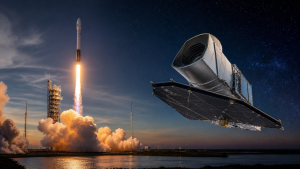
NASA launched the Nancy Grace Roman Space Telescope on 30 August 2026 at 7:26 a.m. EDT from Launch Complex 39A at the Kennedy Space Center in Florida. The observatory flew on a SpaceX Falcon Heavy rocket and began a three-month transfer to the Sun-Earth Lagrange Point 2, or L2, about 1.5 million kilometres from Earth.
Mission Profile
The Nancy Grace Roman Space Telescope is a space observatory with a planned five-year primary mission. NASA has assigned it studies of dark energy, dark matter, and exoplanets. The telescope has a 2.4-metre primary mirror and a field of view about 100 times larger than the Hubble Space Telescope.
Launch and Deployment Sequence
Mission managers confirmed that the 18,000-pound telescope separated from the rocket’s upper stage 31 minutes after liftoff. The spacecraft then deployed its solar arrays, which provide electrical power for onboard systems. As of 31 August 2026, mission scientists had started a 90-day commissioning and calibration phase.
Orbit and Lagrange Point 2
Sun-Earth Lagrange Point 2 is one of the five stable points in the Sun-Earth system. L2 lies on the line joining the Sun and Earth, beyond Earth’s orbit, and it is used by several space observatories because it offers a stable thermal and viewing environment.
Hardware and Development History
The telescope’s core hardware was originally built for a National Reconnaissance Office spy satellite programme. The hardware was donated to NASA in 2012 and later repurposed for astronomy. The mission was launched about nine months ahead of NASA’s committed baseline launch date of May 2027.
Important Facts for Exams
- The Nancy Grace Roman Space Telescope is named after Nancy Grace Roman, the first Chief of Astronomy at NASA.
- Launch Complex 39A at the Kennedy Space Center has also supported Apollo and Space Shuttle missions.
- Sun-Earth Lagrange Point 2 is used by observatories such as the James Webb Space Telescope.
- The Hubble Space Telescope has a 2.4-metre primary mirror, the same diameter as the Roman telescope’s mirror.
Project Cost and Institutional Context
Publicly cited estimates for the project cost have ranged from about US4 billion to US4.3 billion. NASA and SpaceX teams were congratulated during a post-launch news conference on 30 August 2026.
| Related | |
|---|---|



Ayush Singh
September 1, 2026 at 8:22 amCorrection: L2 is one of the five langrange points in the Sun-Earth system. L1, L2, L3= unstable; L4, L5= stable.