NASA Abandons Swift Telescope Rescue Mission
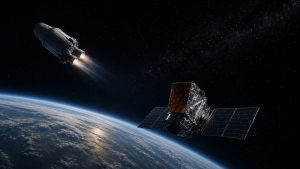
The Neil Gehrels Swift Observatory is a NASA space telescope launched on 20 November 2004 to study gamma-ray bursts and other high-energy cosmic events. NASA later approved a commercial rescue effort for the observatory, but the planned capture and reboost operation was cancelled after repeated control failures in the rescue spacecraft.
Neil Gehrels Swift Observatory
The Neil Gehrels Swift Observatory is a $500 million space observatory designed for rapid detection and follow-up of gamma-ray bursts. It has observed about 1,800 cosmic explosions over more than two decades in orbit. The observatory was orbiting at about 216 miles, or 347 kilometres, before the rescue mission was abandoned.
Commercial Servicing Mission
In September 2025, NASA awarded a $30 million contract to Katalyst Space Technologies, an Arizona-based startup, to develop a commercial mission for orbit-raising of Swift. The mission used a robotic rescue spacecraft named Lightweight In-Space Navigation and Kinematics, or LINK. LINK was launched on 3 July 2026 aboard a Northrop Grumman Pegasus XL rocket from Kwajalein Atoll in the Pacific Ocean.
Mission Failure and Orbit Decay
On 28 July 2026, Katalyst reported that LINK entered a multi-axis spin after a critical attitude-control failure. On 11 August 2026, engineers uploaded new attitude controllers to slow the spin, but pointing and positioning problems continued. On 19 August 2026, NASA and Katalyst called off the primary capture and reboost operation because safe docking was no longer possible.
Important Facts for Exams
- The Neil Gehrels Swift Observatory was launched by NASA on 20 November 2004.
- Gamma-ray bursts are brief, intense flashes of high-energy radiation linked to distant cosmic explosions.
- Attitude control refers to the orientation control of a spacecraft in space.
- Kwajalein Atoll is a Pacific launch site used for some rocket missions.
Future of the Observatory
NASA Administrator Jared Isaacman stated that LINK will still attempt rendezvous and proximity operations near Swift to collect technical data. The Swift Observatory is expected to burn up in Earth’s atmosphere later in 2026, with re-entry likely no earlier than October 2026.
| Related | |
|---|---|