MDU Studies Rice-Husk Biochar for Removing Metals from Wastewater
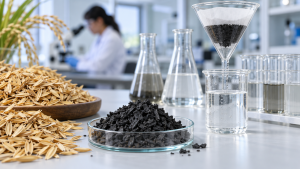
Researchers at Maharshi Dayanand University, Rohtak, studied a rice-husk biochar composite as a material for removing heavy metals from industrial wastewater. The work, reported on 25 August 2026, was conducted by research scholar Anu Kumari under Professor Rachna Bhateria in the Department of Environmental Sciences.
Comparing modified biochar
The study compared ordinary biochar with versions modified using zinc oxide and iron oxide. The iron-oxide-modified material performed best in the reported comparison, which focused on removing hexavalent chromium and lead from contaminated water.
Rice husk was converted into biochar through controlled heating. Further modification changed its surface properties to improve its ability to adsorb the targeted contaminants.
Testing industrial samples
The researchers tested the material in prepared laboratory samples and in electroplating wastewater obtained from Rohtak. Using industrial samples extends the investigation beyond a laboratory solution, but does not establish that a full-scale treatment plant has adopted the technology.
Agricultural residue as a resource
The research connects agricultural-residue use with wastewater treatment. Its next practical questions include performance at larger scale, operating costs and management of the material after it captures contaminants. The August development is a research result, with further technical assessment needed before routine industrial deployment.
| Related | |
|---|---|