Major Space Missions by India
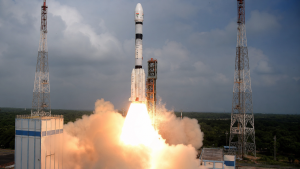
India’s space programme, led by ISRO, has moved from sounding rockets to complex missions covering lunar exploration, Mars orbiting, solar studies, astronomy, navigation, and human spaceflight. For Prelims revision, the most important part is the mission name, launch vehicle, objective, and key outcomes. The following summary brings together India’s major space missions and systems in a compact exam-oriented format.
Lunar Exploration: Chandrayaan Programme
The Chandrayaan series was designed to study the Moon’s mineralogical, chemical, and topographical features. It also marked India’s progress from lunar impact experiments to soft landing capability.
- Chandrayaan-1 (2008): Launched on October 22, 2008, aboard PSLV-C11 from Satish Dhawan Space Centre, Sriharikota.
- Scientific payloads: Carried 11 payloads, including instruments from NASA, ESA, and Bulgaria.
- Moon Impact Probe: The MIP separated from the orbiter and struck near Shackleton Crater on the lunar south pole on November 14, 2008.
- Key discovery: NASA’s Moon Mineralogy Mapper detected hydroxyl and water molecules on the lunar surface.
- Mission life: Operated for 312 days before radio contact was lost in August 2009.
- Chandrayaan-2 (2019): Launched on July 22, 2019, aboard GSLV Mk III-M1 (now LVM3).
- Mission structure: Included an Orbiter, Vikram Lander, and Pragyan Rover.
- Landing outcome: Vikram lost communication at an altitude of 2.1 km and hard-landed on September 7, 2019 due to a software velocity-reduction issue.
- Orbiter status: The Chandrayaan-2 Orbiter remains operational and continues lunar observation through its Orbiter High-Resolution Camera (OHRC).
- Chandrayaan-3 (2023): Launched on July 14, 2023, aboard LVM3-M4.
- Mission components: Consisted of a Propulsion Module, Vikram Lander, and Pragyan Rover.
- Historic landing: Successfully soft-landed on the lunar south polar region on August 23, 2023.
- Named sites: The landing site was named Shiv Shakti Point, while the Chandrayaan-2 crash site was named Tiranga Point.
- Lander payloads: Included ChaSTE, ILSA, and RAMBHA-LP.
- Rover findings: Pragyan used APXS and LIBS instruments and confirmed sulphur, aluminium, calcium, iron, and titanium on the lunar surface.
India became the fourth country to achieve a lunar soft landing and the first to land near the lunar south pole.
| Mission | Launch Date | Launch Vehicle | Mission Type | Major Outcome |
| Chandrayaan-1 | October 22, 2008 | PSLV-C11 | Orbiter & Impact Probe | Water molecules detected |
| Chandrayaan-2 | July 22, 2019 | GSLV Mk III-M1 | Orbiter, Lander, Rover | Orbiter in operation; lander hard landing |
| Chandrayaan-3 | July 14, 2023 | LVM3-M4 | Propulsion Module, Lander, Rover | Successful soft landing |
Interplanetary and Solar Missions
- Mars Orbiter Mission (Mangalyaan / MOM-1): Launched on November 5, 2013, using PSLV-C25 in XL configuration.
- Mars orbit insertion: Entered Martian orbit on September 24, 2014, on its first attempt.
- Significance: India became the first Asian nation to reach Mars orbit and the first country to succeed on its maiden attempt.
- Payloads: Carried five indigenous payloads: MENCA, LAP, MCC, TIS, and MSM.
- Mission duration: Operated for nearly eight years before communication was lost in April 2022.
- Aditya-L1: Launched on September 2, 2023, aboard PSLV-C57.
- Orbit: Placed in a halo orbit around Sun-Earth Lagrange Point 1 (L1), about 1.5 million km from Earth.
- Why L1 matters: Provides uninterrupted solar observation without eclipses or occultation.
- Payloads: Carries seven payloads, including VELC, SUIT, ASPEX, PAPA, SoLEXS, HEL1OS, and digital magnetometers.
- AstroSat: Launched on September 28, 2015, using PSLV-C30.
- Importance: India’s first multi-wavelength space astronomy observatory.
- Observation bands: Studies the universe across ultraviolet, optical, low-energy X-ray, and high-energy X-ray bands simultaneously.
- XPoSat: Launched on January 1, 2024, aboard PSLV-C58.
- Objective: Measures polarization of cosmic X-rays from black holes, neutron stars, and supernova remnants.
- Global significance: India became the second country after the United States to operate a dedicated space observatory for X-ray polarimetry.
- Payloads: POLIX covers the 8-30 keV band, while XSPECT works in the 0.8-15 keV range.
Human Spaceflight: Gaganyaan Programme
- Objective: To demonstrate indigenous human spaceflight capability to Low Earth Orbit.
- Crew target: Plans to place a 3-member crew in a 400 km circular orbit for a 3-day mission.
- Recovery: The crew is expected to return with safe recovery in Indian waters.
- Launch vehicle: Human Rated LVM3 (HLVM3), fitted with a Crew Escape System (CES).
- Orbital module: Includes the Crew Module and Service Module.
- Crew Module: Provides habitable space and life support.
- Key precursor: TV-D1 test flight in October 2023 tested high-altitude crew escape separation.
- Vyommitra: An indigenous female half-humanoid robot designed for uncrewed test missions to monitor environmental parameters.
Navigation, Communication and Earth Observation
- NISAR: A joint Earth-observation mission between ISRO and NASA.
- Radar system: Uses dual-frequency radar—L-band from NASA and S-band from ISRO.
- Technology: Employs SweepSAR to map global land and ice surfaces every 12 days.
- Applications: Useful for tracking ecosystem changes, ice-sheet collapses, and natural hazards.
- NavIC (IRNSS): India’s independent regional satellite navigation system.
- Coverage: Serves India and a region extending 1,500 km around the mainland.
- Constellation: Has a 7-satellite constellation.
- GAGAN: A Satellite-Based Augmentation System developed jointly by ISRO and the Airports Authority of India.
- Use: Supports civil aviation navigation over Indian airspace.
Key Space Facts for Prelims
- National Space Day: August 23 is observed to commemorate Chandrayaan-3’s landing.
- India’s first satellite: Aryabhata was launched on April 19, 1975, using the Soviet Kosmos-3M launch vehicle from Kapustin Yar.
- First indigenous launch vehicle: SLV-3 successfully placed the Rohini (RS-1) satellite into orbit in July 1980.
- Project Director: The SLV-3 mission was led by Dr. A.P.J. Abdul Kalam.
- Main spaceport: Satish Dhawan Space Centre (SHAR), Sriharikota, Andhra Pradesh, is India’s primary spaceport.
- Key theme: India’s space programme covers planetary exploration, astronomy, human spaceflight, navigation, communication, and Earth observation.
Current General Studies comprises current-affairs-based, General Studies-rich study material on policies, laws, institutions, economy, science, environment, governance, international relations, and other varied but important topics for UPSC and State PSC Prelims examinations.
Fortnightly PDF compilations: Available here
Originally written on
June 27, 2026
and last modified on
September 6, 2026.
| Related | |
|---|---|