Major Dairy Breeding and Cloning Technologies in India
Assisted Reproductive Technologies in Bovine Breeding
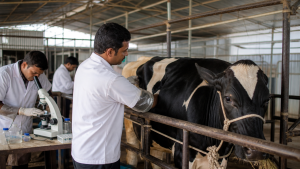
India’s dairy sector is increasingly using advanced breeding tools to raise milk productivity and conserve valuable indigenous bovine genetics. Assisted Reproductive Technologies (ART) help scientists handle gametes and embryos in the laboratory to speed up genetic improvement, improve reproductive efficiency, and multiply superior animals more quickly than conventional breeding. ART covers a range of methods, including Artificial Insemination (AI), Multiple Ovulation and Embryo Transfer (MOET), In Vitro Fertilisation (IVF), Ovum Pick-Up (OPU), and sexed semen technology. These methods are now central to modern dairy development because they allow faster spread of desirable traits, better herd planning, and more precise use of elite germplasm.
- Artificial Insemination (AI): A basic but highly important method for controlled breeding and genetic progress.
- MOET: Multiple Ovulation and Embryo Transfer helps obtain more embryos from superior females than natural reproduction.
- IVF: Enables fertilisation outside the body and embryo production under laboratory conditions.
- OPU: Collects oocytes from live donor females without surgery.
- Sexed semen: Used to influence the sex ratio of calves and improve breeding efficiency.
Ovum Pick-Up and In Vitro Fertilisation
OPU-IVF is one of the most advanced bovine breeding technologies used in India. In this method, immature egg cells are collected from the ovaries of a live donor cow or buffalo through ultrasound-guided, non-surgical ovum pick-up. The collected oocytes are then matured and fertilised in vitro using semen from a selected bull. The resulting embryos are cultured for a few days and then transferred into a recipient cow, which carries the pregnancy as a surrogate mother. This technology is especially useful when the aim is rapid multiplication of a superior female animal. Compared with natural breeding, which usually produces one calf, and even MOET, OPU-IVF can generate a much larger number of calves from a single donor in a year. It is therefore important in programmes that seek faster genetic gain, better milk production, and improved disease resistance.
- OPU: Non-surgical collection of oocytes from a live donor.
- IVF: Fertilisation of the egg outside the body in a laboratory.
- Embryo transfer: The laboratory-created embryo is implanted into a recipient cow.
- Practical value: Useful for rapid multiplication of selected germplasm.
- Outcome: Produces many more calves from one superior female than conventional breeding.
Cloning Technologies in Dairy Livestock
Animal cloning is an asexual reproduction technique that produces a genetically identical copy of an animal without using sperm. The main method is Somatic Cell Nuclear Transfer (SCNT), in which the nucleus of a donor somatic cell is transferred into an enucleated oocyte, that is, an egg cell whose nucleus has been removed. The reconstructed embryo is then activated, cultured, and transferred into a surrogate mother. Cloning is used for two major purposes in livestock research: multiplying elite productive animals and conserving valuable or endangered breeds. In India, cloning research has marked important milestones in bovine science. The world’s first buffalo calf cloned using the Handguided Cloning Technique was born at ICAR-National Dairy Research Institute (NDRI), Karnal, in 2009. More recently, India’s first cloned cattle, a Gir female calf named GANGA, was produced at ICAR-NDRI using OPU for oocyte collection and SCNT for embryo reconstruction.
- SCNT: The principal technique for animal cloning.
- Genetic identity: Cloning produces an animal genetically identical to the donor nucleus source.
- Primary uses: Multiplication of elite stock and conservation of valuable breeds.
- India’s first cloned buffalo: Produced in 2009 at ICAR-NDRI, Karnal.
- India’s first cloned cattle: A Gir female calf produced at ICAR-NDRI in 2025.
Indigenous Breeds and Conservation Priority
India has over 50 officially recognised indigenous cattle breeds, forming a major genetic resource for the dairy sector. These breeds are prized for their adaptability to local climates, disease resistance, and suitability for low-input farming systems. Many are also associated with A2 beta-casein milk, which has attracted consumer interest. Important indigenous dairy breeds include Gir, Sahiwal, Tharparkar, Rathi, Red Sindhi, Kankrej, Hariana, Deoni, and Ongole. The conservation of native breeds has become a policy priority because these animals are better suited to harsh environments and can support sustainable dairying in marginal regions.
Badri cattle are an indigenous genetic resource of Uttarakhand and are recognised as the state animal. Their conservation is important for preserving Himalayan bovine diversity.
Badri cattle are especially relevant in the context of mountain agriculture, where resilience and adaptation matter as much as productivity. Scientists have also generated cloned Badri embryos and are exploring the cloning of elite, high-producing Badri cows, showing how conservation and scientific advancement can go together.
Government Programmes and Research Institutions
The Government of India has supported bovine breeding through targeted schemes and institutional research. The Rashtriya Gokul Mission (RGM), launched in December 2014, focuses on development and conservation of indigenous bovine breeds, genetic upgradation of the bovine population, and improvement in milk productivity. Its interventions include the Nationwide Artificial Insemination Programme, sex-sorted semen, and IVF technology. The mission was realigned for 2021-22 to 2025-26 with an initial outlay of ₹2,400 crore, later enhanced by ₹1,000 crore in March 2025, taking the total to ₹3,400 crore for the 15th Finance Commission cycle. The National Programme for Bovine Breeding and Dairy Development (NPBBDD), launched in February 2014, merged earlier schemes to integrate milk production and dairying in a scientific manner. The National Livestock Mission (NLM), implemented since 2014-15 and revised in 2021-22, supports entrepreneurship, breed improvement, and feed and fodder security.
- Rashtriya Gokul Mission: Main central scheme for indigenous bovine development and conservation.
- RGM interventions: Nationwide AI Programme, sex-sorted semen, and IVF-based breeding support.
- RGM outlay: ₹3,400 crore for 2021-22 to 2025-26 after enhancement in 2025.
- NPBBDD: Launched in February 2014 to integrate dairying activities.
- NLM: Promotes entrepreneurship, breed improvement, and feed security.
- ICAR-NDRI, Karnal: A premier institute for dairy research and cloning work.
- NBAGR, Karnal: The nodal institute for registration of livestock and poultry breeds in India.
Key Prelims Takeaways
- ART: Assisted Reproductive Technologies used to improve animal reproduction and genetic progress.
- OPU-IVF: Produces embryos from donor oocytes collected by ovum pick-up and fertilised in vitro.
- OPU: Non-surgical collection of oocytes from live donor cows or buffaloes.
- SCNT: Main cloning method in livestock, based on nuclear transfer into an enucleated egg.
- India’s first cloned buffalo: Born in 2009 at ICAR-NDRI, Karnal.
- India’s first cloned cattle: Gir female calf GANGA, produced in 2025 at ICAR-NDRI.
- Badri cattle: Indigenous to Uttarakhand and recognised as the state animal.
- Important breeds: Gir, Sahiwal, Tharparkar, Rathi, Red Sindhi, Kankrej, Hariana, Deoni, Ongole.
- Rashtriya Gokul Mission: Launched in December 2014 for indigenous breed development and conservation.
- RGM outlay: ₹3,400 crore for 2021-22 to 2025-26 after enhancement in 2025.
- NPBBDD: Launched in February 2014 for scientific integration of milk production and dairying.
- NLM: Supports breed improvement, entrepreneurship, and feed and fodder security.
- NBAGR: Nodal institute for breed registration in India.
Recent Context
On September 11, 2026, a healthy Badri female calf was born at the Academic Dairy Farm of G.B. Pant University of Agriculture and Technology, Pantnagar, using OPU-IVF technology. The embryo was conceived in the laboratory and transferred into a Sahiwal surrogate cow. The result came from an ongoing three-year research collaboration with ICAR-NDRI, Karnal, and is backed by the Uttarakhand Biotechnology Council.
| Related | |
|---|---|