Examine how the Swadeshi Steam Navigation Company established by V.O. Chidambaram Pillai challenged British maritime monopoly. Why did this economic nationalism struggle to sustain itself?
Founded in 1906, SSNC made economic nationalism a challenge to colonial power. Its contest with the British India Steam Navigation Company (BISNC) revealed the promise and fragility of indigenous enterprise.
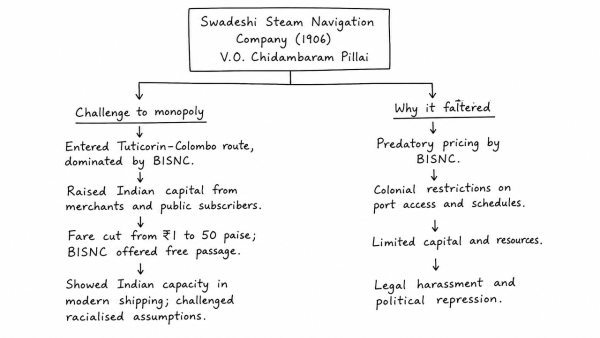
Challenge to monopoly
- It entered the Tuticorin–Colombo route, dominated by BISNC, and raised Indian capital from merchants and public subscribers.
- Fare cuts from one rupee to 50 paise forced BISNC to offer free passage. SSNC demonstrated Indian capacity in modern shipping and challenged racialised assumptions about enterprise.
Why it faltered
- Predatory pricing and colonial restrictions on port access and schedules raised costs; intimidation deterred investors and ticket sellers.
- Undercapitalisation, debt, weak professional management and a shortage of trained Indian maritime officers undermined resilience; internal disagreements compounded these problems.
- VOC’s 1908 arrest removed its driving force; SSNC was liquidated in 1911.
Its collapse reflected colonial inequality and institutional weaknesses. Yet it made self-reliance tangible and inspired future efforts to build Indian maritime capacity.
Originally written on
October 15, 2026
and last modified on
October 15, 2026.