Japan’s Kikai Caldera Slowly Refills with Magma
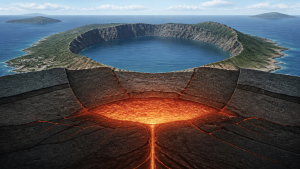
On 23 October 2026, researchers from Kobe University described evidence that magma is gradually accumulating beneath Japan’s Kikai Caldera. The caldera formed during the Kikai-Akahoya eruption about 7,300 years ago, one of the largest volcanic eruptions of the Holocene Epoch.
Kikai Caldera and the Kikai-Akahoya Eruption
Kikai Caldera is an underwater volcanic depression in southern Japan. A caldera forms when a volcano’s summit or surrounding ground collapses after a large volume of magma is withdrawn during an eruption. The Kikai-Akahoya eruption produced extensive volcanic deposits in southern Japan and formed the caldera. The present research concerns magma accumulating beneath the caldera long after that eruption. The researchers found that the magma currently present is newly injected material, rather than simply molten remnants of the ancient eruption.
Seismic Imaging of the Magma Reservoir
A Kobe University-led team worked with the Japan Agency for Marine-Earth Science and Technology (JAMSTEC) to investigate the underwater structure. Ship-based surveys used ocean-bottom seismometers and an air-gun system to generate seismic signals and map structures below the seafloor. The surveys identified a magma body at depths of approximately 2.5–6 kilometres beneath the caldera, directly below its central lava dome. The seismic findings provide evidence of a large underground reservoir that has accumulated magma since the ancient eruption.
Lava Dome and Magma Composition
The central lava dome has been forming for approximately 3,900 years. Chemical analysis of the dome’s lava indicates that the melt is linked to newly injected magma, rather than material left over from the Kikai-Akahoya eruption. The study led by Akihiro Nagaya was published in “Communications Earth & Environment”. Researchers describe the accumulation as a slow process occurring over thousands of years; the findings do not indicate that an eruption is imminent.
Important Facts for Exams
- A caldera is a large volcanic depression formed by collapse following the withdrawal of magma.
- The Kikai-Akahoya eruption occurred about 7,300 years ago.
- The identified magma body lies approximately 2.5–6 kilometres beneath the seafloor, below Kikai’s central lava dome.
- Ocean-bottom seismometers record seismic waves used to investigate geological structures beneath the seabed.
Magma Recharge at Aira Caldera
Aira Caldera, which is associated with Sakurajima volcano, has also been undergoing magma recharge. Its reservoir has been refilling since the 1914 eruption, and studies suggest that it could approach its pre-1914 pressure within decades.
| Related | |
|---|---|