International Law of the Sea: Key Principles, UNCLOS
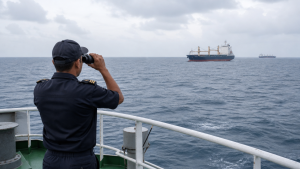
The International Law of the Sea sets the legal framework for the use of oceans, maritime zones, navigation rights, and marine resources. At its centre is the United Nations Convention on the Law of the Sea (UNCLOS), which balances the rights of coastal states with the shared interests of the international community.
UNCLOS also provides institutions and dispute-settlement mechanisms for maritime governance, including rules for the high seas, the deep seabed, and protection of the marine environment.
UNCLOS: Structure and Maritime Zones
UNCLOS was adopted in 1982 and entered into force on November 16, 1994. As of September 2026, it has 172 parties. The United States and Iran are among the notable non-parties.
- Internal Waters: Water bodies landward of the baseline. The coastal state exercises full sovereignty, and foreign vessels do not have an automatic right of passage.
- Territorial Sea: Extends up to 12 nautical miles (nm) from the baseline. The coastal state has sovereignty over the water, seabed, and airspace, subject to the right of innocent passage for foreign vessels.
- Contiguous Zone: Extends from 12 nm to 24 nm. Here, the coastal state may take limited action to prevent and punish infringements of customs, fiscal, immigration, or sanitary laws.
- Exclusive Economic Zone (EEZ): Extends up to 200 nm from the baseline. The coastal state has sovereign rights to explore, exploit, conserve, and manage living and non-living resources in the water column and seabed.
- Continental Shelf: Consists of the seabed and subsoil extending to the outer edge of the continental margin, or up to 200 nm. The coastal state has exclusive sovereign rights over mineral and non-living resources.
- High Seas: All parts of the sea outside the territorial sea, EEZ, internal waters, or archipelagic waters. No state may claim sovereignty over them, and they are open to all states.
The Area and the International Seabed Authority
Under UNCLOS Part XI, the deep seabed beyond national jurisdiction is called the Area. Its mineral resources are treated as the common heritage of mankind and cannot be claimed or appropriated by any state or private entity.
The Area is administered by the International Seabed Authority (ISA), an autonomous intergovernmental organization based in Kingston, Jamaica. Leticia Reis de Carvalho of Brazil assumed office as ISA Secretary-General on January 1, 2025, for a four-year term.
The deep seabed beyond national jurisdiction is not subject to state sovereignty; its resources are governed collectively under UNCLOS.
Biodiversity Beyond National Jurisdiction Agreement
The BBNJ Agreement, also called the High Seas Treaty, is a legally binding instrument for conserving and sustainably using marine biological diversity in areas beyond national jurisdiction.
- Ratification milestone: Morocco became the 60th state to ratify the treaty on September 19, 2025, triggering the countdown for entry into force.
- Entry into force: The agreement entered into force on January 17, 2026.
- Ratification status: As of 2026, the treaty has 145 signatories and over 90 ratifying parties.
- Governance: The first Conference of the Parties, or COP-1, is scheduled from January 11 to 22, 2027.
- Voting rights: Only states that ratified the treaty before the conference will have voting rights at COP-1.
Institutional Framework of ITLOS
The International Tribunal for the Law of the Sea (ITLOS) is an independent judicial body established by UNCLOS to adjudicate disputes arising from the interpretation or application of the convention.
- Headquarters: Hamburg, Germany.
- Composition: 21 independent judges elected for nine-year terms.
- President: Judge Tomas Heidar of Iceland for the 2023–2026 term.
- Vice-President: Judge Neeru Chadha of India for the 2023–2026 term.
Recent Case Law and Advisory Opinions
ITLOS has also shaped recent interpretation of maritime law through advisory opinions and dispute settlement.
- May 21, 2024: ITLOS issued an advisory opinion stating that greenhouse gas emissions constitute marine pollution.
- Legal implication: Under UNCLOS, states are obligated to take necessary measures to prevent, reduce, and control marine pollution from climate change impacts.
- May 27, 2026: The ITLOS Special Chamber delivered its final judgment in the M/T “Heroic Idun” (No. 2) Case (Marshall Islands/Equatorial Guinea).
- June 12, 2026: ITLOS constituted a Special Chamber to hear the maritime boundary delimitation dispute between Ghana and Togo in the Gulf of Guinea.
- July 18, 2026: The ITLOS Seabed Disputes Chamber issued orders on requests for provisional measures in Case 34 and Case 35 involving Nauru and Tonga-related mining disputes.
- February 9, 2026: The Zheng He case (Luxembourg v. Mexico) was struck off the tribunal’s list after an out-of-court settlement.
Key Prelims Takeaways
- UNCLOS: Adopted in 1982 and in force since November 16, 1994.
- State parties: 172 parties as of September 2026; the United States and Iran are notable non-parties.
- Territorial sea: Extends up to 12 nm from baselines and permits innocent passage.
- EEZ: Extends up to 200 nm and gives coastal states sovereign rights over resources.
- The Area: Deep seabed beyond national jurisdiction, governed as the common heritage of mankind.
- ISA: Based in Kingston, Jamaica, and administers mineral resources in the Area.
- ITLOS: Headquartered in Hamburg, Germany, with 21 judges and jurisdiction over UNCLOS disputes.
| Related | |
|---|---|