INST Mohali Develops Nanofibre Filter for Dye-Contaminated Wastewater
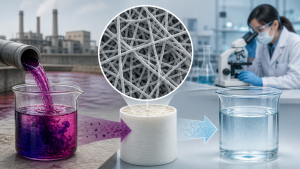
The Institute of Nano Science and Technology (INST), Mohali, developed a sustainable catalytic filter for treating dye-contaminated wastewater, announced on 14 October 2026. The filter combines zinc oxide (ZnO) nanoparticles and biodegradable polylactic acid (PLA) nanofibres, using light and mechanical vibrations to break down pollutants.
Composition and Green Synthesis
The filter’s active material consists of ZnO nanoparticles incorporated into PLA nanofibres. PLA is a biodegradable polyester used in materials including packaging and biomedical products. ZnO is a semiconductor material used in photocatalytic applications. Researchers synthesised the ZnO nanoparticles using turmeric extract. Compounds in the extract acted as natural reducing and stabilising agents during nanoparticle preparation, avoiding harmful chemical reagents in this synthesis process.
Photocatalysis and Piezocatalysis
Photocatalysis uses light to activate a catalyst and promote chemical reactions that degrade pollutants. Piezocatalysis uses mechanical stress or vibrations to generate charge carriers in certain materials, which can participate in pollutant-degradation reactions. The filter combines these processes: light activates photocatalytic activity, while mechanical vibrations contribute piezocatalytic activity. The PLA nanofibres provide a support structure for the ZnO nanoparticles in the catalytic filter.
Performance and Research Context
The PLA-ZnO nanofibres achieved decolourisation efficiencies of 98.6% for Methylene Blue and 96.7% for Congo Red within 120 minutes. The material also inactivated approximately 75% of “Escherichia coli” and 71% of “Staphylococcus aureus” after six hours. The study integrated machine learning to predict dye-decolourisation performance using variables including wavelength, treatment time and catalyst quantity. The prediction accuracy reached up to 99%. The research findings were published in “Advanced Functional Materials”. INST Mohali is an autonomous institute under India’s Department of Science and Technology.
Important Facts for Exams
:
- Methylene Blue is a synthetic dye used in laboratory and industrial applications.
- Congo Red is an azo dye containing the –N=N– azo group.
- “E. coli” is a Gram-negative bacterium, while “S. aureus” is Gram-positive.
- Photocatalysis involves light-activated chemical reactions at a catalyst’s surface.
INST Mohali operates under the Department of Science and Technology. The filter combines biodegradable PLA nanofibres with turmeric-extract-synthesised ZnO nanoparticles.
| Related | |
|---|---|