India’s Nuclear Command and Control Architecture
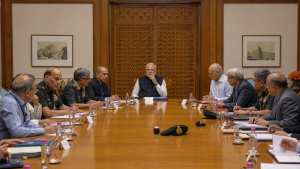
India’s nuclear command and control architecture is a civilian-led framework designed to ensure secure custody, careful decision-making, and credible deterrence. It separates political authorization from military execution so that nuclear use remains tightly controlled under a clear chain of command.
The Nuclear Command Authority
The Nuclear Command Authority (NCA) was formally established by the Cabinet Committee on Security on January 4, 2003. It is the apex body for command, control, and operational decisions relating to India’s nuclear weapons programme.
- Political Council: The sole authority empowered to order a retaliatory nuclear strike. It is chaired by the Prime Minister of India.
- Executive Council: It provides inputs to the NCA and executes the directives of the Political Council. It is chaired by the National Security Advisor (NSA).
- Civilian control: The structure ensures absolute civilian authority over the nuclear arsenal and reduces the risk of unauthorized or accidental launch.
Strategic Forces Command
The Strategic Forces Command (SFC) is the integrated tri-service command that functions as the operational arm of the NCA. Established in 2003, it translates political decisions into military execution.
- Operational role: It manages, administers, and operationalizes India’s tactical and strategic nuclear weapons stockpile and delivery assets.
- Command chain: It acts as the final link between the political leadership and the armed forces.
- Coordination: The SFC coordinates with the Chief of Defence Staff (CDS) and the three service chiefs.
- Tri-service character: Its structure brings together personnel and assets from the Army, Navy, and Air Force for unified nuclear command arrangements.
Nuclear Doctrine and Legal Framework
India’s nuclear posture is guided by its doctrine and domestic legal framework. The emphasis is on deterrence, survivability, and restraint rather than warfighting.
- Credible Minimum Deterrence (CMD): India maintains a minimum force sufficient to deter adversaries while preserving a survivable retaliatory capability.
- No First Use (NFU): India states that it will not initiate a nuclear strike. It reserves the right to retaliate massively in response to a nuclear attack on Indian territory or Indian forces anywhere.
- Atomic Energy Act, 1962: This is the primary law governing nuclear activities, radioactive minerals, and strategic nuclear materials under the control of the Central Government.
- International posture: India is not a signatory to the Treaty on the Non-Proliferation of Nuclear Weapons (NPT) or the Comprehensive Nuclear-Test-Ban Treaty (CTBT).
- Testing moratorium: India maintains a voluntary unilateral moratorium on nuclear explosive testing.
Sea-Based Deterrent and Nuclear Triad
The sea-based leg of India’s nuclear triad is central to ensuring second-strike capability and continuous deterrence. Under the Advanced Technology Vessel (ATV) project, India has developed nuclear-powered ballistic missile submarines (SSBNs).
- INS Arihant: Commissioned in 2016, it was India’s first indigenous SSBN and displaced approximately 6,000 tonnes.
- INS Arighaat: Commissioned on August 29, 2024, it is the second Arihant-class SSBN and also displaces approximately 6,000 tonnes.
- INS Aridhaman: Commissioned on April 3, 2026, it is a larger 7,000-tonne SSBN with eight vertical launch system (VLS) silos.
- S4″ submarine: The fourth Arihant-class SSBN, designated S4″, is undergoing sea trials.
- Continuous At-Sea Deterrence (CASD): The SSBN fleet is intended to support persistent underwater deterrence and improve survivability.
Missiles and Land-Based Advances
India’s sea-based and land-based deterrent systems complement each other within the broader triad. The missile force provides flexibility in range, deployment, and response options.
- K-15 missile: A submarine-launched ballistic missile with a range of approximately 750 km.
- K-4 missile: A submarine-launched ballistic missile with a range exceeding 3,000 km.
- Mission Divyastra: Under this programme, the DRDO has conducted two successful flight tests of the Agni-5 missile equipped with Multiple Independently Targetable Re-entry Vehicle (MIRV) technology.
- Agni-5 MIRV tests: The first test was on March 11, 2024, and the second test was on May 8, 2026.
Key Prelims Takeaways
- NCA: Established on January 4, 2003, it is the apex body for India’s nuclear command and control.
- Political Council: Chaired by the Prime Minister; only this body can authorize a retaliatory nuclear strike.
- Executive Council: Chaired by the NSA; it provides inputs and executes decisions of the Political Council.
- SFC: The operational arm of the NCA and the final link in the command chain.
- Doctrine: India follows Credible Minimum Deterrence and a declared No First Use policy.
- Legal basis: The Atomic Energy Act, 1962 is the principal statute governing nuclear activities.
- Triad: Key SSBNs include INS Arihant, INS Arighaat, and INS Aridhaman; S4* is under sea trials.
- Missile systems: The sea-based deterrent includes the K-15 and K-4 SLBMs.
- MIRV capability: Mission Divyastra relates to Agni-5 tests with MIRV technology.
- Treaties: India is outside the NPT and CTBT but maintains a voluntary testing moratorium.
| Related | |
|---|---|