India’s First Port-Based E-Methanol Facility Announced
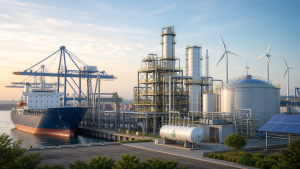
India’s first port-based e-methanol production facility is being developed at Deendayal Port Authority in Kandla, Gujarat. The project is a joint initiative of Deendayal Port Authority, with 76% ownership, and Assam Petro-Chemicals Ltd, with 24% ownership. The total investment for the project is ₹2,300 crore, and the planned production capacity is 150 tonnes per day.
E-Methanol as a Fuel
E-methanol is a synthetic form of methanol produced using renewable power, water, and biogenic carbon dioxide. Methanol is an alcohol with the chemical formula CH3OH and is used as an industrial feedstock and marine fuel. Green methanol is one of the alternative fuels being considered for shipping and heavy transport.
Project Phases and Capacity
The project will be executed in two phases. Phase I involves a 50 tonnes per day unit with an estimated cost of ₹1,200 crore and a target completion date of January 2027. Phase II will add 100 tonnes per day at a cost of ₹1,100 crore and is targeted for completion by March 2027. The combined output will reach 150 tonnes per day after both phases are completed.
Port-Based Green Fuel Infrastructure
Deendayal Port Authority is located at Kandla in Gujarat and functions under India’s major port system. Port-based fuel facilities are linked to maritime bunkering, storage, and supply operations for vessels. The e-methanol from this project is planned for supply to ships operating on the Asia-Europe International Trade Corridor.
Important Facts for Exams
- Deendayal Port Authority is one of India’s major ports and is located at Kandla in Gujarat.
- Assam Petro-Chemicals Ltd is a public sector company associated with petrochemical production in India.
- Methanol is a single-carbon alcohol and is used in chemicals, fuels, and industrial processes.
- India has set a net-zero emissions target for 2070.
Related Maritime Green Fuel Facility
V.O. Chidambaranar Port in Tuticorin has also taken up a pilot Green Methanol Bunkering and Refuelling Facility. The project is linked to cleaner fuel use in the maritime sector and to bunkering operations at Indian ports.
| Related | |
|---|---|