India’s First National Tribal Olympiad Set for December
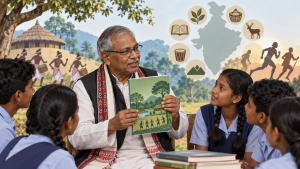
The first National Tribal Olympiad (NTO) is scheduled for 13 December 2026. The initiative was discussed by adviser Mahadev Toppo at a Tata Steel Foundation tribal convention in Jamshedpur, which concluded on 19 November. The report was datelined Bhubaneswar, Odisha, on 20 November 2026.
Eligibility, syllabus and origin
Only tribal students in Classes VI–X are eligible. More than 1,500 applications had been received, and the application deadline was extended from 30 October to 29 November 2026. The syllabus covers Adivasi history, heritage, culture, constitutional rights, literature, arts, Indigenous knowledge, the environment, food traditions, sports, self-governance, festivals and tribal achievers.
The workbook Rashtriya Adivasi Olympiad, to which Toppo contributed, contains 626 questions and answers. Ajay Kerketta, a member of Team Dhumkudia, first proposed an “Adivasi Knowledge Olympiad”. Team Dhumkudia is a community institution in Ranchi that works to preserve Indigenous knowledge.
Toppo cited athletes Animesh Kujur, Kranti Goud and Salima Tete, and writer Hansda Sowvendra Shekhar, among tribal achievers whose contributions the Olympiad aims to familiarise students with. Its stated objective is to build pride and confidence in Adivasi identity.
Important Facts for Exams
- Intergenerational transmission: Indigenous knowledge often develops through accumulated observation of the environment and is transmitted orally across generations.
- Cultural dimensions: Traditional knowledge can encompass language, classification, resource-use practices, ritual and spirituality, linking practical understanding with a wider cultural worldview.
- Scheduled Tribe notification: Article 342 of the Constitution enables the President to specify Scheduled Tribes for each State or Union Territory; Parliament alone may subsequently amend those lists by law.
- PESA and Gram Sabhas: PESA 1996 extends Part IX of the Constitution, with modifications, to Fifth Schedule areas and gives Gram Sabhas responsibilities for customary practices and community resources.
| Related | |
|---|---|