India Develops Small Machine for Fusion Research
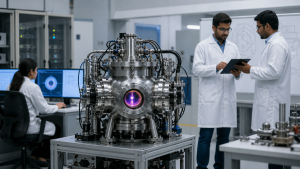
India has added two small-scale spherical tokamaks to its fusion research base in 2026. Bengaluru-based Pranos Fusion developed Pragya, while the Institute for Plasma Research (IPR) in Gandhinagar completed and operated its own compact spherical tokamak for plasma experiments.
Pragya and spherical tokamak design
Pragya is a compact, low-aspect-ratio spherical tokamak. A spherical tokamak is a type of magnetic confinement device with a more compact plasma chamber than a conventional tokamak, and it is used in fusion research to study plasma behaviour under strong magnetic fields.
Pragya was completed on 21 August 2026 and launched on 3 September 2026. It was built in eight months by a 12-member team led by Shaurya Kaushal and Roshan George.
Institute for Plasma Research and first plasma
IPR completed the mechanical and electrical integration of its small-scale spherical tokamak on 23 August 2026. The machine achieved its first plasma on 30 August 2026, which is the stage when ionised gas is successfully confined and sustained inside the device.
By 7 September 2026, IPR scientists had carried out 114 plasma discharges on the machine. They also adjusted magnetic coils to address electrical instabilities during the early experimental phase.
Fusion infrastructure in India
India’s existing fusion infrastructure includes the ADITYA-U tokamak and SST-1 at IPR. India also holds a 9% stake in ITER, the international fusion experiment under construction in France.
Pragya is not designed for commercial electricity generation. It is planned as a 20-year experimental testbed with about 3,000 shots per year for research on plasma control and high-temperature superconducting magnets.
Important Facts for Exams
- Tokamaks use magnetic fields to confine plasma at temperatures required for nuclear fusion research.
- Spherical tokamaks have a more compact geometry than conventional tokamaks.
- ITER is an international fusion project located in France.
- High-temperature superconducting magnets are used in advanced fusion device designs.
Research ecosystem and future plans
Pranos Fusion is co-incubated at the Institute for Plasma Research and the Jawaharlal Nehru Centre for Advanced Scientific Research (JNCASR). The company plans to make its proprietary HTS magnet technology operational by 2027 and to deploy a full-scale reactor named Praniq by 2030.
| Related | |
|---|---|