India backs genome-edited rice varieties
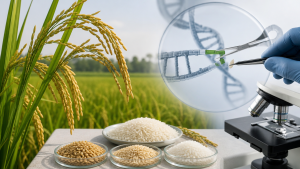
India launched its first two genome-edited rice varieties, DRR Dhan 100 (Kamala) and Pusa DST Rice 1, on 4 May 2025 in New Delhi. The varieties were developed under Indian agricultural research institutions and use genome-editing methods linked to CRISPR-Cas9.
Genome editing in crops
Genome editing is a technique that alters specific DNA sequences in a plant genome without necessarily adding foreign DNA. CRISPR-Cas9 is one of the best-known genome-editing tools and is used in SDN-1 and SDN-2 type edits in crop research.
DRR Dhan 100 (Kamala)
DRR Dhan 100 (Kamala) was developed from the Samba Mahsuri rice variety. It matures about 15 to 20 days earlier than the parent line and has a crop duration of around 130 days. Field data linked to the variety place its yield gain in the range of 19% to 25%.
Pusa DST Rice 1
Pusa DST Rice 1 was developed from Cotton Dora Sannalu, also known as MTU1010. It is designed for drought and salinity tolerance. Under saline stress, the variety has shown yield gains of up to 30.36%.
Institutional framework and research base
The Indian Council of Agricultural Research, ICAR-IIRR in Hyderabad, and ICAR-IARI in New Delhi are among the institutions associated with the development and testing of these rice lines. The All India Coordinated Research Project on Rice, AICRPR, has been used for field trials and performance assessment.
Important Facts for Exams
- CRISPR stands for Clustered Regularly Interspaced Short Palindromic Repeats.
- SDN-1 and SDN-2 are genome-editing categories that do not introduce foreign genes.
- Rice is a self-pollinated cereal crop and belongs to the family Poaceae.
- India is one of the largest producers and consumers of rice in the world.
Policy and yield targets
The “Minus 5 and Plus 10” formula aims to reduce rice cultivation area by 5 million hectares and increase output by 10 million tonnes on the remaining land. Such targets are linked to higher productivity per hectare in Indian agriculture.
Research and patent context
The genome-editing techniques used for these rice lines were linked to research work partly developed in laboratories associated with Healthy Crops and Prof. Wolf B. Frommer. Patent-linked scientific work is a common feature in modern biotechnology and crop improvement.
Regulatory context
Genome-edited crops that do not contain foreign DNA are treated differently from transgenic genetically modified organisms in several regulatory systems. In India, biosafety assessment for such crops depends on the nature of the edit and the applicable scientific and regulatory review process.
| Related | |
|---|---|