Important Indian Standards for Electronics and Accessories
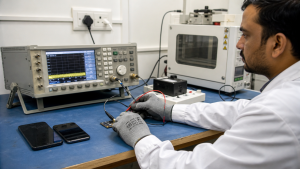
BIS standards are central to India’s electronics ecosystem because they link product safety, quality control and legal market access. For consumers, they reduce the risk of faulty or unsafe devices; for manufacturers and importers, they define the compliance path for selling notified products in India. The latest addition to this framework is smartphone screen protectors.
Bureau of Indian Standards (BIS)
The Bureau of Indian Standards (BIS) is India’s national standards body. It was established under the Bureau of Indian Standards Act, 2016, which came into force on October 12, 2017, replacing the earlier 1986 law. BIS functions under the Ministry of Consumer Affairs, Food and Public Distribution.
BIS plays a key role in product standardisation, certification and consumer protection. In the electronics segment, its standards are especially important because devices are widely traded, frequently imported and closely linked to safety and performance requirements.
- Standard-setting: BIS formulates and publishes Indian Standards for goods, services and processes.
- Product certification: It operates certification schemes such as the ISI Mark scheme and the Compulsory Registration Scheme (CRS).
- System certification: BIS also provides certification for quality management systems.
- Testing support: It conducts testing and calibration through its laboratory network.
- Public interest powers: The BIS Act allows the central government to mandate a standard mark on notified goods in the interest of consumer safety, environmental protection, national security or fair trade.
- Compliance models: The Act also enables simplified conformity assessment, including self-declaration of conformity in suitable cases.
Compulsory Registration Scheme (CRS) for Electronics
The Compulsory Registration Scheme (CRS) is the main compliance route for many electronics and IT goods in India. It was introduced by the Ministry of Electronics and Information Technology (MeitY) in coordination with BIS through the Electronics and Information Technology Goods (Requirement for Compulsory Registration) Order, 2012, notified on October 3, 2012.
The scheme was designed to keep substandard electronics out of the market while supporting the growth of a more reliable electronics industry. Over time, the list of notified products has expanded significantly.
- Initial coverage: The 2012 order began with 15 product categories.
- Expanded scope: CRS now covers more than 76 electronic and IT products.
- Examples: Covered items include laptops, tablets, smartphones, LED lights, power adapters and smartwatches.
- Mandatory nature: Notified products cannot be manufactured, stored for sale, imported, sold or distributed in India without CRS compliance.
- Registration number: BIS issues a unique registration number, commonly called the R-number, after approval.
- Coverage: The requirement applies to both Indian and foreign manufacturers, as well as importers.
CRS works on a test-and-self-declare basis. Products must be tested in BIS-recognized laboratories before registration is granted. Unlike schemes involving factory inspection, CRS relies on product testing and documentary verification before market entry.
Important Indian Standards for Electronics
BIS has developed several Indian Standards for electronic goods and accessories. These standards define minimum safety, compatibility and performance requirements, and in some cases also address language inclusion or charging harmonisation.
- IS 13252 (Part 1):2010: Covers safety requirements for information technology equipment such as computers, peripherals, networking devices, mobile phones, laptops and power adapters/chargers. It sets electrical, mechanical and environmental safety parameters.
- IS 19014 (IS/IEC 62368-1:2023): The earlier IT equipment safety framework is being transitioned to this unified standard for audio/video, information and communication technology equipment.
- IS 16333 (Part 3):2022: Mandates Indian language support in mobile phone handsets sold in India, including input, display and reading features.
- IS 616:2017: Specifies safety requirements for audio, video and similar electronic apparatus such as televisions, speakers and projectors.
- IS 16046 (Part 1 & 2):2018: Applies to lithium-ion and lithium-polymer batteries used in portable devices such as smartphones, laptops and power banks. These standards align with the IEC 62133 framework.
- IS 16047 (Part 3):2018 / IEC 61960-3:2017: Used for verification of battery capacity as per updated compliance guidance.
- IS 10322 series, IS 16102 and IS 16103: Cover LED lighting products, including self-ballasted LED lamps, LED luminaires and performance requirements for LED modules.
- USB Type-C (IS/IEC 62680-1-3:2022): Supports a common charging solution for smartphones and other devices, helping reduce the number of chargers consumers need.
Process of BIS CRS Registration
Manufacturers seeking CRS registration must complete testing and documentation before the product can be sold in India. The process is intended to ensure that notified electronic goods meet the relevant Indian Standard before entering the market.
- Testing: The product is tested in a BIS-recognized, NABL-accredited laboratory in India.
- Documentation: Applicants submit the application form, test report, business registration details, factory information and trademark details, if applicable.
- Authorized Indian Representative: Foreign manufacturers must appoint an Authorized Indian Representative (AIR).
- Online filing: The application is submitted through the BIS MANAK portal.
- Scrutiny: BIS examines the application and supporting documents.
- Certificate issuance: On approval, BIS grants CRS registration with a unique R-number.
- Validity: The registration is product- and model-specific and is generally valid for two years, subject to renewal.
Why Indian Standards Matter
Indian Standards are not only technical documents; they are also regulatory tools that shape market behaviour. In the electronics sector, they directly support industrial compliance and standardisation while improving consumer confidence.
- Consumer safety: They help reduce risks such as electrical hazards, overheating and product failure.
- Quality assurance: Certification assures buyers that products meet defined benchmarks of reliability and performance.
- Market access: Mandatory BIS certification is a legal requirement for notified products sold in India.
- Fair trade: The same safety and quality rules apply to domestic as well as imported goods.
- Environmental benefits: Standards can support energy efficiency and lower environmental impact.
Exam focus: CRS is a product-testing-and-registration model, while the BIS Act empowers the government to make standard marks mandatory for notified goods in the public interest.
Key Prelims Takeaways
- BIS is India’s national standards body.
- BIS operates under the Bureau of Indian Standards Act, 2016.
- The BIS Act, 2016 came into force on October 12, 2017.
- CRS for electronics was introduced by MeitY in 2012.
- CRS covers more than 76 electronic and IT products.
- R-number is the unique registration number issued under CRS.
- IS 13252 (Part 1):2010 is a key IT equipment safety standard.
- IS 16333 (Part 3):2022 provides for Indian language support in mobile handsets.
- IS 16046 (Part 1 & 2):2018 covers lithium-ion battery safety.
- USB Type-C has been standardised under IS/IEC 62680-1-3:2022.
- Indian Standards help ensure safety, quality, legal compliance and fair market access.
Recent Context
MeitY issued a notification on September 21, 2026, making BIS certification mandatory for smartphone screen protectors under IS 19348:2025. The rule will apply from April 1, 2027, after a transition period ending on March 31, 2027, and covers manufacturers and importers selling screen protectors in India.
| Related | |
|---|---|