IIT-BHU and Parul University researchers develop nanocomposite that removes up to 92.91% of Eriochrome Black T dye
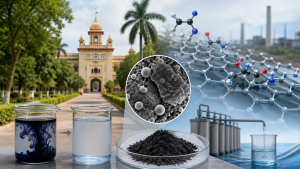
Researchers from IIT (BHU) and Parul University developed a nanocomposite to remove persistent dyes from industrial wastewater. The study, published on 4 November 2026, reported up to 92.91% removal of Eriochrome Black T under optimised conditions, with adsorption equilibrium reached in about 30–40 minutes.
Composition and adsorption performance
The material combines tin oxide (SnO₂), graphene and the electrically conductive polymer polypyrrole, and was prepared through a single-pot synthesis process. The polypyrrole coating limits particle aggregation, helping retain active sites for dye adsorption. Eriochrome Black T is an azo dye used in industrial processes, including textiles.
Researchers used Response Surface Methodology to assess factors including pH, adsorbent quantity, dye concentration, contact time and temperature. The model predicted 92.90% removal, compared with the measured 92.91%; the reported maximum adsorption capacity was 434.8 milligrams per gram.
Reuse and publication
After six uses, the material retained about 77% dye-removal efficiency. Regeneration with sodium hydroxide showed declining performance: removal fell from about 93% to 63% after six cycles. The findings appeared in the Journal of Inorganic and Organometallic Polymers and Materials.
Important Facts for Exams
- Semiconducting oxide: Tin(IV) oxide is usually regarded as an oxygen-deficient n-type semiconductor, a material property of one nanocomposite constituent.
| Related | |
|---|---|