IISER Pune Startup Develops Atomic Clock for Navigation
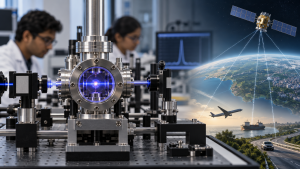
As of 21 November 2026, QuPrayog, a deep-tech startup incubated at the I-HUB Quantum Technology Foundation at IISER Pune, has developed a laboratory-scale atomic clock prototype using rubidium-87 atoms. The prototype was completed in seven months.
Prototype performance
Laboratory tests recorded frequency stability of about 3 × 10⁻¹⁰ over one second, improving to around 2 × 10⁻¹¹ over 100 to 1,000 seconds. Over 1,000 seconds, the prototype improved the stability of an ordinary crystal oscillator by about 50 times.
Development plans and support
Founded in 2024 by Dr Jay Mangaonkar and Dr Rahul Sawant, QuPrayog is also incubated at the IIT Madras Incubation Cell. It aims to launch a miniature version by August 2027 and plans compact, rugged clocks for satellite navigation, telecommunications and scientific instruments, while exploring optical atomic clock technology. Its technology development is supported by India’s deep-tech ecosystem, including the National Quantum Mission, approved in 2023 with an allocation of ₹6,003.65 crore over eight years for indigenous quantum technologies, including quantum sensing and precision measurement.
Important Facts for Exams
- Atomic resonance: Atomic clocks measure time by monitoring resonant frequencies associated with transitions between atoms’ quantised energy levels.
- SI time standard: The SI second is defined through the unperturbed ground-state hyperfine transition frequency of caesium-133, fixed at 9,192,631,770 hertz.
- Clock stability: Clock stability describes performance averaged over time to reduce the effects of noise and short-term fluctuations.
- Isotope decay: Rubidium-87 is radioactive, with a half-life of about 49.7 billion years, and beta-decays into stable strontium-87.
| Related | |
|---|---|