New Bristle Worm Species Found Along Odisha and West Bengal Coasts
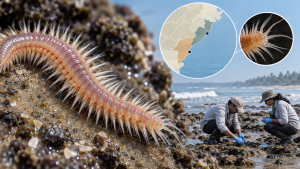
Scientists reported the discovery of Hypereteone indica, a new marine bristle worm, on November 20, 2026, from intertidal zones at Udaipur beach in Odisha and Hijli beach in West Bengal. It is the first addition to the genus Hypereteone from Indian waters in nearly a century; the genus now has 10 recognised species worldwide.
Recent bristle worm discoveries
Dr S Balakrishnan of the Zoological Survey of India’s Marine Aquarium and Regional Centre, Digha, led the study with research scholars S Krishnaraj and Chaiti Manna, and Brazilian researcher Veronica Maria de Oliveira. Researchers collected 12 specimens—six from each beach—during low tides in August, September and December 2025. Separately, Paraleocrates indica was found in the Champa Estuary’s intertidal mudflats in West Bengal. Surveys from December 2023 to April 2024 led by the Zoological Survey of India and Mexican collaborators recorded this rare genus in Indian waters for the first time; the discovery was reported on February 9, 2026.
Other marine worm findings
On February 6, 2026, the Zoological Survey of India and international researchers announced two new nereidid worms from Digha and Bankiput in West Bengal: Namalycastis solenotognatha and Nereis dhritiae. The former has specialised jaws with multiple canals and inhabits sulfide-rich, organically enriched mudflats. Nereis dhritiae honours Dhriti Banerjee, the first woman Director of the Zoological Survey of India. Separately, Berhampur University researchers discovered the microscopic marine nematode Ceramonema leduci off Gopalpur, Odisha, in December 2024; the findings were published around November 15, 2026.
Important Facts for Exams
- Animal nomenclature rules: For species-group names established after 1999, ICZN rules require explicit fixation of a name-bearing type and identification of its depository collection.
- Nereidid reproduction: Many nereidids undergo epitoky, a transformation into a swimming reproductive form that can participate in mass spawning.
- Nematode development: Nematodes are unsegmented ecdysozoans; their development typically involves four moults, each shedding the cuticle, before adulthood.
- Sediment engineering: Many burrowing polychaetes ventilate sediment galleries, transporting oxygen downward and influencing nutrient cycling beyond their immediate burrows.
| Related | |
|---|---|