What is Skyroot’s Vikram-1 Mission?
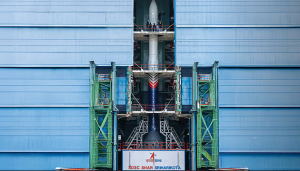
Skyroot Aerospace has announced a launch window for Vikram-1 from 12 July to 4 August 2026. The mission, named Mission Aagaman, is planned from the Satish Dhawan Space Centre-SHAR in Sriharikota and involves India’s first privately built orbital rocket.
Vikram-1 Launch Vehicle
Vikram-1 is a seven-storey, multi-stage orbital launch vehicle developed by Hyderabad-based Skyroot Aerospace. It uses an all-carbon composite structure and is designed to carry small satellites of up to 350 kg to low Earth orbit.
Mission Aagaman and Flight Objectives
The main objective of Mission Aagaman is to collect real-time flight performance data across multiple systems. The mission is also intended to validate design parameters for future vehicle development.
Development Milestones and Earlier Flight
As of 1 July 2026, all stages of Vikram-1 had been integrated and stacked at the launch pad. The flight-ready rocket was unveiled by Prime Minister Narendra Modi in November 2025 during the inauguration of Skyroot’s Infinity campus. Skyroot’s earlier mission, Vikram-S, launched on 18 November 2022 and became India’s first privately built rocket to reach space. The upcoming Vikram-1 flight will carry payloads from domestic and international customers in a partially commercial configuration.
Important Facts for Exams
- Satish Dhawan Space Centre-SHAR is India’s spaceport at Sriharikota in Andhra Pradesh.
- Low Earth orbit is commonly used for Earth observation satellites and small satellite constellations.
- Carbon composite structures are used in launch vehicles for high strength and lower mass.
- Vikram-S was a suborbital rocket, while Vikram-1 is an orbital launch vehicle.
| Related | |
|---|---|