Dairy Analogues and Substitute Foods
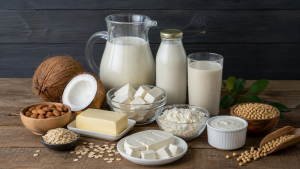
Dairy analogues are food products made to imitate the taste, texture, appearance, and function of traditional dairy, but they do not come from animal milk. They are increasingly used in plant-based foods and in low-cost substitutes for milk, paneer, butter, and ghee.
What are Dairy Analogues?
Dairy analogues are formulated from plant-based ingredients or synthetic proteins. Common sources include soy, oats, almonds, coconuts, and vegetable oils. Their demand is rising due to lactose intolerance, milk allergies, vegan diets, environmental concerns, and low-cost food substitution.
Types of Dairy Analogues and Substitute Foods
- Plant-Based Beverages: Direct substitutes for liquid milk made from grains, nuts, or seeds. Examples include soy, almond, oat, coconut, and rice beverages.
- Plant-Based Cheese and Butter: Made to mimic melting and spreading properties, often using cashew paste, coconut oil, potato starch, and nutritional yeast.
- Precision Fermentation Dairy: Uses genetically engineered microorganisms such as yeast or fungi to produce proteins identical to cow milk proteins, especially casein and whey.
- Adulterated and Modified Analogues: Commercial substitutes where milk fat or milk solids are replaced with vegetable fats. Examples include analogue paneer, analogue khoya, and analogue ghee.
Regulatory Framework in India
The Food Safety and Standards Authority of India (FSSAI) regulates dairy analogues under the Food Safety and Standards (Food Products Standards and Food Additives) Regulations, 2011.
Definition and Labeling Rules
- Definition of Milk: FSSAI defines milk as the normal mammary secretion obtained from the udder of healthy milch animals.
- Restriction on Dairy Terms: Products made entirely from plant-based or non-dairy sources cannot use words like “milk,” “butter,” “cheese,” “curd,” or “yogurt” on primary labels.
- Negative Declarations: Labels must clearly declare non-dairy ingredients and specify the absence of milk constituents, such as “Contains [non-dairy source]” or “Contains no milk fat.”
- Exemptions: Traditional terms in long usage, such as “coconut milk” and “peanut butter,” are allowed if they are not misleading.
New Directions and Consultation
- Prefix Requirement: Analogue products may be required to carry the prefix “non-dairy” or “analogue” on labels.
- Ingredient Transparency: Packaged items may need to mention substitutes on the front of the pack, such as “contains palm oil as a milk fat substitute.”
- HoReCa Sector Rules: Hotels, restaurants, and catering services must declare the use of analogues on menus, such as “Burger with Cheese Analogue.”
Detection and Quality Control
- Beta-Sitosterol Marker: Laboratories test for beta-sitosterol, a phytosterol found in plant oils, to detect vegetable fats in suspected ghee or paneer.
- Surveillance Drives: FSSAI conducts targeted testing campaigns, especially during festive seasons, to check adulterated khoya, paneer, and ghee.
Nutritional Comparison: Dairy vs. Plant-Based Analogues
| Nutrient Parameter | Traditional Cow Milk | Soy Beverage (Unfortified) | Almond Beverage (Unfortified) |
| Protein Content | High, around 3.2 g per 100 ml; contains all essential amino acids. | Moderate, around 2.5 g per 100 ml; good-quality plant protein. | Very low, under 1 g per 100 ml. |
| Calcium Bioavailability | High; easily absorbed due to lactose and casein. | Low unless fortified with calcium carbonate or tricalcium phosphate. | Low unless artificially fortified. |
| Fat Type | Saturated fats; contains cholesterol. | Polyunsaturated and monounsaturated fats; cholesterol-free. | Monounsaturated fats; cholesterol-free. |
| Vitamins | Naturally rich in B-vitamins, especially B12 and B2. | Lacks vitamin B12 naturally; requires fortification. | Lacks vitamin B12 naturally; contains some vitamin E. |
Technological Methods in Producing Analogues
- Homogenization: High-pressure processing breaks down plant fats and proteins to create a stable emulsion and prevent separation.
- Fortification: Manufacturers add vitamins such as Vitamin D2 and Vitamin B12, along with minerals like calcium phosphate, to match cow milk nutrition.
- Additives and Emulsifiers: Ingredients such as guar gum, xanthan gum, and lecithin improve thickness and mouthfeel.
Environmental and Economic Impacts
- Lower Emissions: Plant-based alternatives generally produce fewer greenhouse gas emissions than dairy cattle.
- Resource Conservation: They usually require less land and water than maintaining dairy herds.
- Livelihood Risks: Dairy is a major agricultural sector in India, and millions of rural households depend on daily milk income.
- Unfair Competition: Cheap vegetable-fat-based analogues sold as genuine dairy can reduce prices and hurt farmers’ earnings.
- Misleading Marketing: Improper labeling can confuse consumers about whether a product is real dairy or a substitute.
Recent Context
Karnataka has banned the sale of analogue paneer marketed as “paneer” for one year, from August 17, 2026, to August 17, 2027. The move targets imitation products with vegetable fats or oils and follows similar restrictions in several other states.
Rare Facts for Prelims
- Casein and whey are the two key milk proteins that precision fermentation aims to replicate.
- Beta-sitosterol is used as a marker because it is common in plant oils but absent in genuine dairy fat.
- Tricalcium phosphate is a frequent calcium fortificant in plant-based milk alternatives.
- Paneer is a fresh acid-set cheese, unlike ripened cheeses that undergo aging.
- Vitamin B12 is naturally present in animal foods but usually absent in unfortified plant beverages.
- HoReCa stands for hotels, restaurants, and catering services.
| Related | |
|---|---|