Major Classical Dances of India and Their Origins
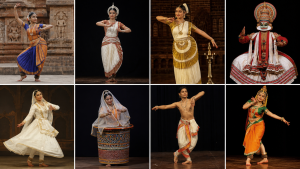
India’s classical dance traditions reflect a long cultural continuum shaped by temple worship, courtly patronage, devotional literature and ancient performance theory. Though each form has a distinct regional style, all are rooted in codified movement, expressive storytelling and spiritual aesthetics.
The eight classical dances recognized by the Sangeet Natak Akademi draw on Sanskrit treatises, local traditions and centuries of refinement. For Prelims, the most important areas are their origin, posture, costume, music, repertoire and associated institutions or reformers.
Classical Dance Framework
Classical Indian dance is traditionally explained through Sanskrit dramaturgy and aesthetics. The same framework helps in distinguishing one dance form from another.
- Natyashastra: Authored by Sage Bharata between 200 BCE and 200 CE; it is the principal text on drama, music and dance.
- Abhinaya Darpana: Written by Nandikesvara; it explains mudras, postures and facial expressions.
- Sangeeta Ratnakara: Authored by Sharangadeva in the 13th century; it links northern and southern traditions of music and dance.
- Nritta: Pure, rhythmic movement without narrative content.
- Nritya: Expressional dance using gestures and facial expressions to convey meaning.
- Natya: Dramatic representation involving character, dialogue and plot.
- Tandava: Vigorous, forceful movement associated with Lord Shiva.
- Lasya: Graceful, delicate movement associated with Goddess Parvati.
Bharatanatyam and Kathak
Bharatanatyam and Kathak are among the most widely known classical forms, but their origins and movement vocabularies differ sharply.
- Bharatanatyam: Originated in Tamil Nadu and is linked to the Devadasi tradition; it was historically known as Sadir Attam.
- Bharatanatyam: Marked by a fixed upper torso, bent knees known as Araimandi, angular lines and complex rhythmic footwork.
- Bharatanatyam: The traditional sequence includes Alarippu, Jatiswaram, Shabdam, Varnam, Padam, Tillana and Slokam.
- Bharatanatyam: Associated with E. Krishna Iyer, Rukmini Devi Arundale and the Tanjore Quartet; Rukmini Devi founded Kalakshetra.
- Kathak: Originated with Kathakars, or wandering storytellers, and later developed in Mughal courts.
- Kathak: Known for fast footwork (tatkar), rapid spins (chakkars) and an upright body posture.
- Kathak: Major gharanas are Lucknow, Jaipur, Banaras and Raigarh.
- Kathak: Lucknow gharana is noted for grace and abhinaya, while Jaipur gharana emphasizes footwork and speed.
Kathakali, Kuchipudi and Odissi
These three forms are strongly theatrical, yet each has a distinct performance grammar and visual identity.
- Kathakali: Developed in Kerala in the 17th century under the patronage of the King of Kottarakkara.
- Kathakali: Drew from Kutiyattam and Ramanattam; it is a dance drama with elaborate facial makeup and large headgear.
- Kathakali: Uses 24 primary hand gestures as described in Hastalakshana Deepika.
- Kathakali makeup: Pacha for heroic or divine characters, Kathi for villainous roles, Thadi for bearded types and Kari for demonesses.
- Kathakali: Vallathol Narayana Menon founded Kerala Kalamandalam.
- Kuchipudi: Originated in Andhra Pradesh and was codified by Siddhendra Yogi in the 17th century.
- Kuchipudi: Combines fast movements with dramatic dialogue.
- Kuchipudi: Its famous Tarangam involves dancing on the edge of a brass plate while balancing a pot of water on the head.
- Kuchipudi repertoire: Includes Jatiswaram, Shabdam, Manduka Shabdam, Bhamakalapam and Tarangam.
- Odissi: Evolved from the Mahari and Gotipua traditions of Odisha.
- Odissi: Early visual evidence is found in the 2nd-century BCE relief sculptures of the Udayagiri-Khandagiri caves.
- Odissi: Built on Chowk (square stance) and Tribhanga (three-bend posture).
- Odissi repertoire: Usually progresses through Mangalacharan, Battu Nrutya, Pallavi, Abhinaya and Moksha.
Sattriya, Manipuri and Mohiniyattam
These traditions show the close link between dance, devotion and regional religious practice in eastern and southern India.
- Sattriya: Introduced in the 15th century by Srimanta Sankardeva in the monastic Sattras of Assam.
- Sattriya: Traditionally performed by male monks called Bhokots.
- Sattriya: Training includes Mati Akhara postures, said to be 64 in number, and Ankiya Nats.
- Sattriya music: Uses Borgeet, along with the Khol drum and Bhor Taal cymbals.
- Manipuri: Rooted in the ancient Lai Haraoba festival and Krishna Rasa Leela traditions of Manipur.
- Manipuri: Characterized by soft, fluid, circular movements without sharp jerks.
- Manipuri costume: Dancers wear a cylindrical stiff skirt called Kumil or Potloi.
- Manipuri Rasa Leela: Includes Vanta Rasa, Maha Rasa, Vasanta Rasa, Kunj Rasa and Nitya Rasa.
- Mohiniyattam: The traditional female solo dance of Kerala; the name means “Dance of the Enchantress.”
- Mohiniyattam: Associated with the Mohini avatar of Vishnu and noted for swaying movements resembling palm fronds and ocean waves.
- Mohiniyattam costume: Uses white or off-white Kasavu saris with gold borders.
- Mohiniyattam: Features gentle circular torso movements and intricate footwork set to Sopana Sangeetam.
Quick Comparison Table
| Dance Form | Origin / Source | Key Feature | Major Accompaniment / Note |
| Bharatanatyam | Tamil Nadu; Devadasi tradition | Araimandi, angular lines, rhythmic footwork | Carnatic music, Nattuvangam |
| Kathak | North India; storytellers and Mughal courts | Tatkar and Chakkars | Tabla, Pakhawaj, Lehra |
| Kathakali | Kerala; Kutiyattam and Ramanattam | Elaborate makeup and eye movements | Chenda, Maddalam, Chengila |
| Kuchipudi | Andhra Pradesh; Siddhendra Yogi | Tarangam and dramatic dialogue | Carnatic music, Mridangam |
| Odissi | Odisha; Mahari and Gotipua traditions | Chowk and Tribhanga | Odissi music, Mardala |
| Sattriya | Assam; Srimanta Sankardeva and Sattras | Mati Akhara training | Khol, Bhor Taal, Borgeet |
| Manipuri | Manipur; Lai Haraoba and Vaishnavism | Soft, circular movements | Krishna Rasa Leela traditions |
| Mohiniyattam | Kerala; female solo tradition | Swaying, graceful torso movement | Sopana Sangeetam |
Key Prelims Takeaways
- Eight classical dance forms: Bharatanatyam, Kathak, Kathakali, Kuchipudi, Odissi, Sattriya, Manipuri and Mohiniyattam.
- Two key texts: Natyashastra and Abhinaya Darpana are central for classical dance theory.
- Movement categories: Nritta, Nritya and Natya are the basic technical divisions.
- Important posture terms: Araimandi, Chowk, Tribhanga and Tandava/Lasya are frequently asked in exams.
- Temple and devotional roots: Many forms evolved from temple rituals, monastic settings or sectarian traditions.
- Distinct regional identity: Each dance is tied to a state and a characteristic costume, music style or stage convention.
- Institutional relevance: Names such as Kalakshetra and Kerala Kalamandalam are important for revision.
| Related | |
|---|---|