China’s Chang’e-7 Mission Targets Moon’s South Pole
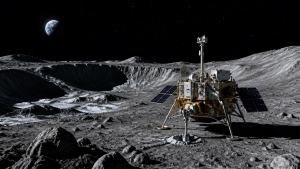
China has scheduled the Chang’e-7 lunar mission for launch on 24 August 2026 from the Wenchang Spacecraft Launch Site in Hainan aboard a Long March 5 Y14 rocket. The China National Space Administration has described the spacecraft as a four-in-one system with an orbiter, lander, rover and hopping probe for exploration of the lunar south pole.
Mission Design and Components
The Chang’e-7 spacecraft uses a four-in-one configuration that combines four separate elements in one mission architecture. The orbiter will operate around the Moon, while the lander will attempt a touchdown near the edge of Shackleton Crater. The rover will move on the lunar surface, and the hopping probe will enter difficult terrain for direct sampling.
Lunar South Pole and Water Ice Search
The primary target of Chang’e-7 is the lunar south pole, a region that contains permanently shadowed craters. The lander is planned to search for signs of water ice near Shackleton Crater, which is one of the best-known impact craters near the Moon’s south pole. The hopping probe will use active shock-absorption technology to jump into shadowed craters and analyse water molecules.
Scientific Payloads and Communications
The mission will carry six scientific payloads supplied by six different countries and one international organisation. The spacecraft will use the Queqiao-2 relay satellite, launched in March 2024, to maintain communications between Earth and the lunar surface. The relay satellite is part of China’s lunar communication network for far-side and polar missions.
Important Facts for Exams
- Chang’e is the name of China’s lunar exploration programme, named after the Chinese moon goddess Chang’e.
- The lunar south pole contains permanently shadowed regions that can preserve volatile substances such as water ice.
- Shackleton Crater is a prominent impact crater near the Moon’s south pole and is a key site in lunar exploration plans.
- Queqiao-2 is a relay satellite used for communication support in lunar missions, especially for regions not directly visible from Earth.
Related Lunar Exploration Context
China’s Chang’e programme has included orbiters, landers, rovers and sample-return missions in earlier phases. The Chang’e-7 mission belongs to China’s broader lunar exploration effort focused on polar science, surface mobility and resource detection.
| Related | |
|---|---|