China’s $168 Billion Brahmaputra Dam and Flood Risks
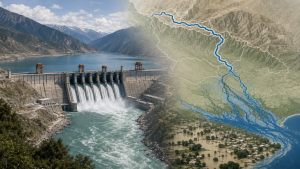
The Brahmaputra River, known as the Yarlung Tsangpo in Tibet, flows east across the Tibetan Plateau before turning south towards India and Bangladesh. Chinese researchers have warned that the river could experience increased runoff and higher flood risks during this century. The proposed hydropower project in Medog, Tibet, is estimated to cost $168 billion and is expected to have a capacity exceeding 60,000 megawatts.
River Runoff and Climate Research
Researchers from the Chinese Academy of Sciences and Yunnan University combined climate data with reconstructed river-runoff records spanning 1325–2020. The long-term runoff reconstruction used tree-ring data from the southeastern Tibetan Plateau. Their findings were published in the journal “China Science Bulletin” on 8 October 2026. Runoff is the volume of water that flows over land and reaches rivers, lakes or other water bodies. Changes in precipitation, snow and glacier melt, and temperature can alter river runoff. The Tibetan Plateau is warming at approximately twice the global average, a trend that can affect its hydrological cycle and drought and flood patterns.
Dam Location and Hydropower Capacity
The proposed dam is planned in a Himalayan gorge near an active fault line beneath the project site. In July 2026, Chinese geologists raised concerns about the fault and called for strengthened slopes to address landslide risks. The gorge lies near the disputed border with India, where the Yarlung Tsangpo makes a sharp U-turn before entering India. The project is intended to become the world’s largest hydropower installation, with planned capacity of more than 60,000 megawatts. This is nearly three times the installed capacity of China’s Three Gorges Dam, which is 22,500 megawatts. Hydropower generates electricity by using moving or falling water to drive turbines.
Downstream River and Water Management
After entering India, the river flows through Arunachal Pradesh and Assam, and then crosses into Bangladesh, where its main channel is known as the Jamuna. India and Bangladesh rely on the river and have raised concerns about possible effects on water flows, flood management and ecosystems. China’s Foreign Ministry has stated that the project will not affect downstream countries and that safety has been examined through studies. India was planning a large downstream dam to provide storage capacity and manage variations in river flow as of 26 October 2026.
Important Facts for Exams
:
- The Brahmaputra is known as the Yarlung Tsangpo in Tibet and the Jamuna in Bangladesh.
- The proposed Medog project is planned in a seismically active Himalayan gorge.
- The Three Gorges Dam has an installed capacity of 22,500 megawatts.
- Tree rings can preserve information used to reconstruct past climate and hydrological conditions.
The Brahmaputra is a transboundary river shared by China, India and Bangladesh. The proposed project’s planned capacity exceeds 60,000 megawatts.
| Related | |
|---|---|