Earth’s Second-Oldest Orbicular Rock Found in Madhya Pradesh
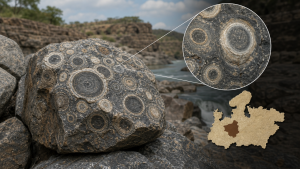
The Pichhore orbicular granite near Kutawali village in Shivpuri district, Madhya Pradesh, has been dated to about 2.56 billion years. It is the second-oldest known orbicular rock in the world, after a similar formation in Western Australia.
Orbicular Granite
Orbicular granite is a rare igneous rock that contains orbicules, which are spherical or rounded structures formed within the rock mass. These orbicules are commonly made of quartz and feldspar and may show concentric layers similar to tree rings.
Geological Age and Dating Method
Scientists used Uranium-Lead, or U-Pb, zircon dating to determine the age of the Pichhore granite. Zircon is a mineral widely used in geochronology because it can preserve isotopic information for billions of years. The rock crystallised around 2.56 billion years ago during the Neoarchean Era. Inherited zircon crystals in the sample were as old as 3.5 billion years, which places them among the oldest mineral records in the Indian shield.
Bundelkhand Craton and Ancient Crust
The rock occurs within the Bundelkhand Craton, one of the oldest geological blocks in India. A craton is a stable part of the continental crust that has remained largely undeformed for long geological periods. The presence of older zircon fragments in the granite indicates recycling of ancient continental crust during early Earth history. The Bundelkhand Craton is a key region for studying the evolution of the Indian shield and Precambrian geology.
Important Facts for Exams
- The Pichhore orbicular granite is located near Kutawali village in Shivpuri district, Madhya Pradesh.
- Orbicules are rounded structures that can reach up to 30 centimetres in diameter.
- Uranium-Lead dating of zircon is a standard method for determining very old rock ages.
- The study involved researchers from Banaras Hindu University, IIT Kanpur, IISER Berhampur, the University of Campinas, and JAIST.
Scientific Collaboration
The study was published in the journal Geosystems and Geoenvironment. It involved researchers from Banaras Hindu University, IIT Kanpur, IISER Berhampur, the University of Campinas in Brazil, and the Japan Advanced Institute of Science and Technology.
| Related | |
|---|---|